Further information can be found on Alisa Gvozdeva’s Instagram, @vizhu.figu, and through her gallery, GALLERIE MERMAN.
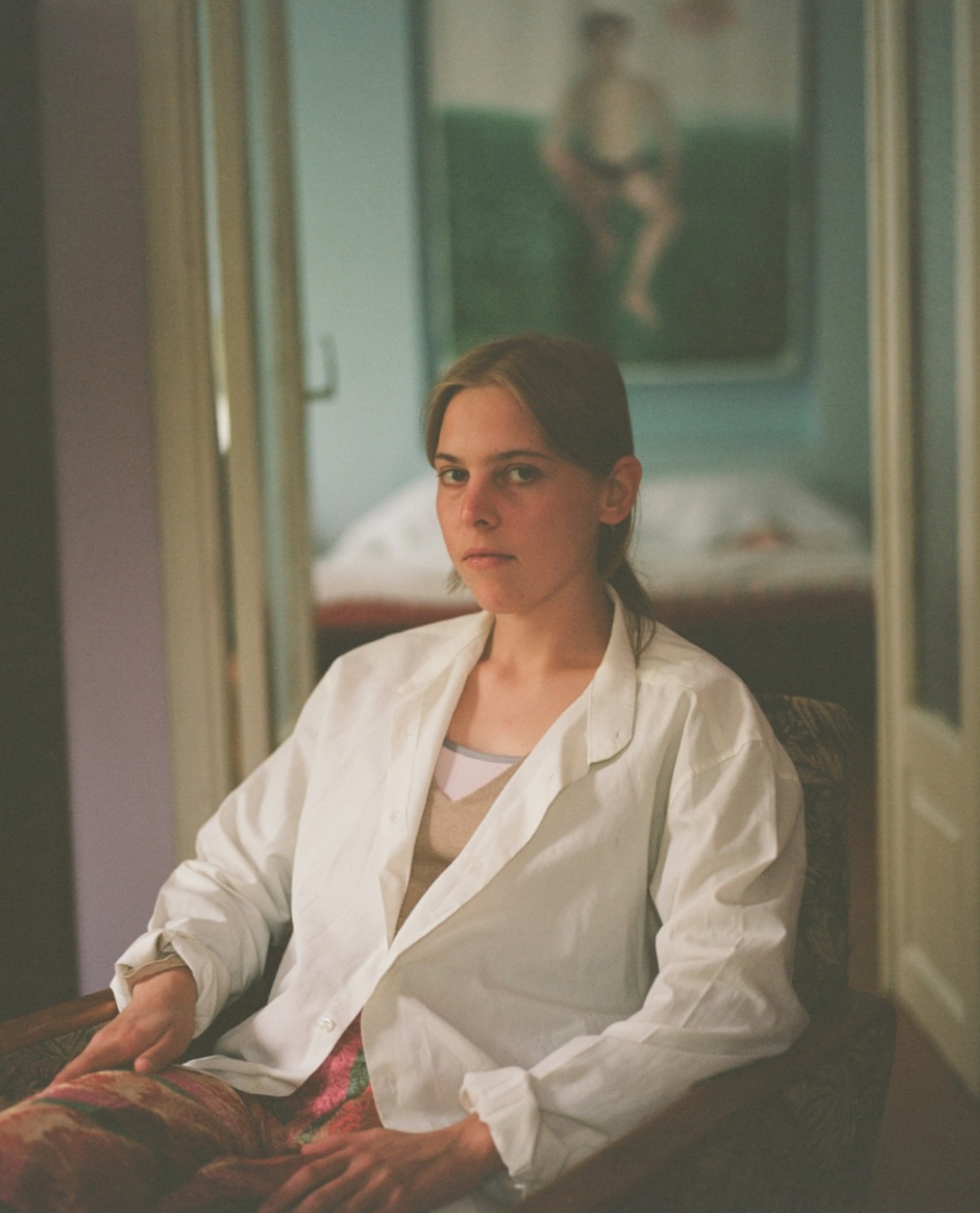
Alisa Gvozdeva. Photo courtesy of Gvozdeva.
Alisa Gvozdeva teleports to lands where we are born anew, and our souls and spirits discover themselves and their surroundings as if for the first time. Gvozdeva’s work tells stories of the physical and spiritual sides of our world, and reflects back to us our organic beginning.
What was your first introduction to art?
I first thought of an art school I attended as a kid, but then I imagined the city itself - my native town is Saint Petersburg; it’s full of magic and beauty and some special mystical energy. I think of it now a lot as I’m making a new series of works in dedication to this place and that time.
What memory from your childhood do you think played a significant role in your development in the arts ?
I know this exact moment. I was left home alone while being sick, my mum used to order one journal for kids, they published a new issue about different painters each month. While I was alone and sick with temperature about 39.9 I had an issue about Bosch. It truly amazed me and I even wrote about it in a school essay, it was 4th grade. I think it was my first personal, not imposed by adults impression in arts, what made me interested.
In a collaboration with Moscow-based gallery SAMPLE in 2024, you said, “Until recently, the unconscious was a leading role in my work, but now light has become the subject of my study. Now I am interested in a conscious action, the creation of a certain vibration coming from the picture”. The surrealist planes of life in your work heavily represent dreamscapes and alternate versions of the natural universe. Do you find that today, you have continued to grow in your conscious action and intentionality in the actual figures in your pieces, or would you say that you have let more of the unconscious back in?
You noticed it very correctly :) it was a crisis moment in my art practice, where I understood the lack of depth and volume in my images and I really thought that painting from life is the next step. I usually work from head, from imagination, from unconscious, but at that moment I wanted to bring the process closer to playing music, being more concentrated on each move and stroke, notice every shadow and reflex. For now, I separated this two practices, my strength as an artist is imagination and joy of creating something, what I never saw before. I see my development in art as a natural process of evolution. As a self taught artist I was never ruled by academic knowledge, but I comprehended it organically during years of practice, intuitively repeating certain stages in the evolution of human art.
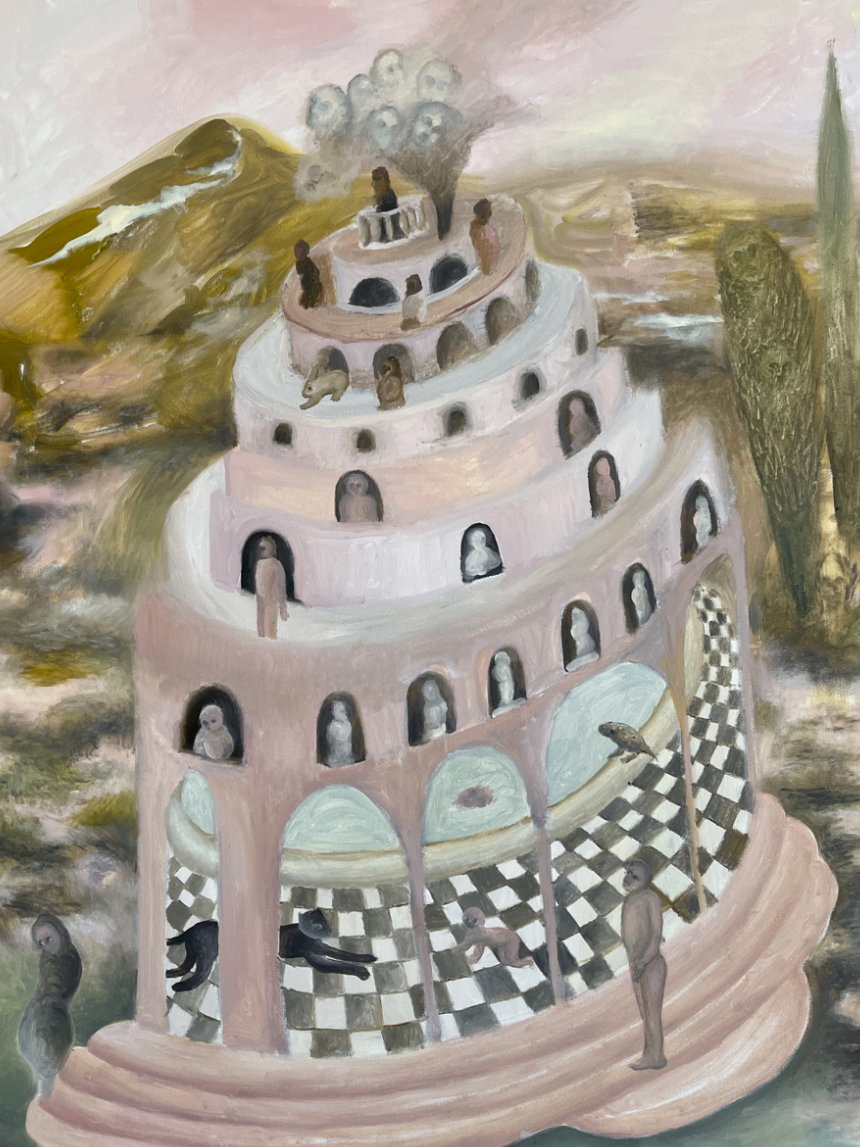
Babylon, 2024. Gvozdeva. Photo courtesy of Gvozdeva.
Some of your pieces in their composition have a sort of religious benevolence. The facial expressions, the layout make me think of a bit of church paintings around the 14th-15th century, the kind of change from medieval to Renaissance-style painting. Are these kinds of religious frescoes something you draw inspiration from?
Yes of course and many more. This is what comes naturally, my plots and characters are kind of medieval, I think that’s because medieval painters also didn’t really know how to paint :) It’s very “mind” thing. When you’re working in academic tradition you don’t paint an ear or a nose or an eye, you paint lights and shadows. But ancient painters, who created icons or traditional arts they painted exactly the nose or the ear they imagine in their head and that’s what I usually do. It’s pleasant to me that you identify it more to Renaissance, that means to me that I’m still developing and probably coming to new stage of my style.
Do you have a religious background yourself? If so, can you say a little about what it is if you feel comfortable to do so?
I’m happy I grew up without any religion, it’s an often story in Post-soviet countries, it gave me the freedom to understand this part of life by myself. I always had strange and colourful dreams, searched for mysticism, lived somewhere above the clouds. I believe in magic and the strength of mind. I think every religion is very poetic in the end, though strictly following the rules of any religion is ugly to me.
Your work often uses pastels, muted tones, and colours that seem to have an almost greyish wash. What is the effect you feel these colours give?
I just use the colours which I find pleasant together. In the beginning my palette was full of very bright, even artificial colours, with years my perception just changed, today I use oil colors and I love natural pigments. I think it’s similar to what the child experience when it starts to get acquainted with tastes, at first every taste is too strong and during life receptors become more subtle and so does the taste.
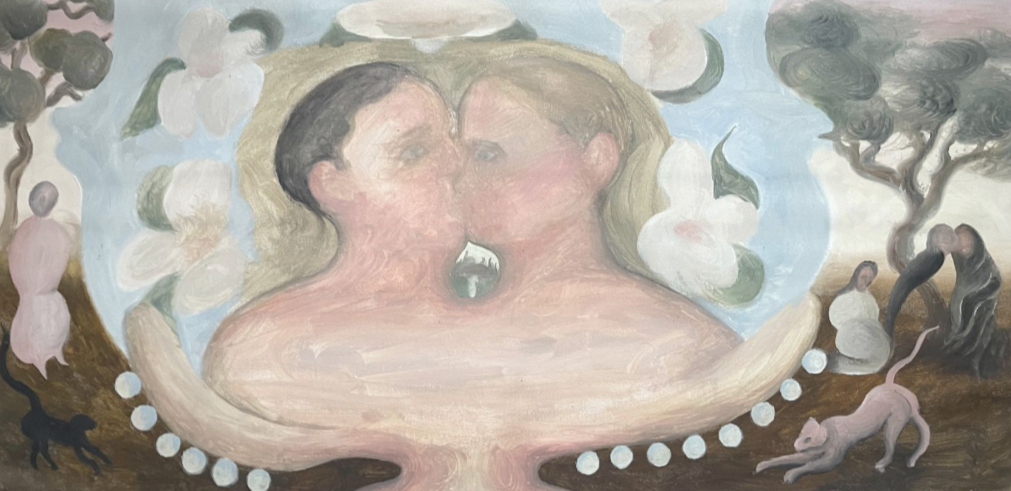
Kiss. Gvozdeva. Photo courtesy of Gvozdeva.
Does your colour palette in your paintings extend to the colour palette of yourself, your own style, your personal world?
I think so, one day I just looked at the mirror and found that it’s my usual color palette, rose, green, gold - it’s literally me. Besides, I have different moods and my attentive viewers always know when I’m in depressive stages.
What other Russian artist do you really admire, either because of their work or because of who they are?
For me it’s russian composers- Rachmaninov, Prokofiev, Stravinsky, Scriabin. Scriabin because who he is. He had very interesting beliefs and life I think, he wanted to build a temple in India to play his last piece and the theosophical crowd around him they believed that this act would turn Universe and time in back direction, literally he believed it would create an apocalypse. I think it’s a great performance idea and I only could imagine what was behind this story, I think they had fun.
What artist’s practice do you think you would find most fun to partake in for a day?
I think painters life is boring sometimes, but speaking about russian artists I would love to stay at a place in Abramtesovo, an so called art residency where stayed and worked many great painters of 19th century, I think today art residences miss that organic flow.
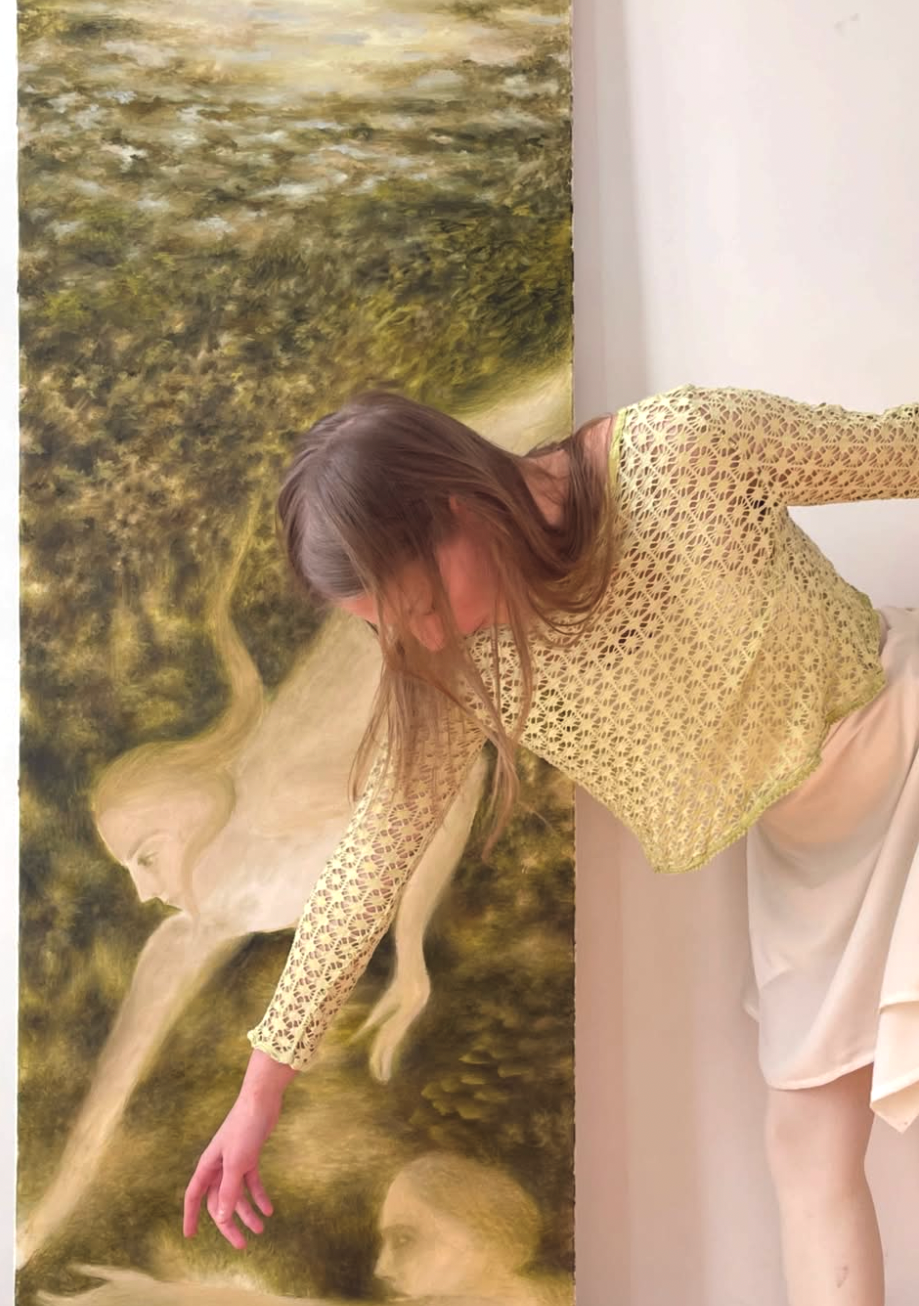
Alisa Gvozdeva. Photo courtesy of Gvozdeva.
How do you go about beginning the process of creating a work of art? What is the first step? What is the last step?
I don’t have the exact method for making a new work, it can be an idea that was growing in my mind for years, or just freestyle. I try not to stuck on one method and balance with different mediums - when I’m done with painting, I come back to objects, one really supports the other. I also started to improvise music few years ago, it’s a totally different approach and I also love to dance alone in my room. Sometimes going out of the city is the best way to refresh your mind. The main thing for the beginning is not to suffer for the result and doing what feels right.
When it finally comes to painting, the last steps are the hardest, that’s where suffer usually appears, the beginning was bright and fun, but bringing the body to some perfect point is a mastery.
What is your current favourite colour? Has this always been your favourite colour?
All colours of course!
What is your favourite medium of art?
Music
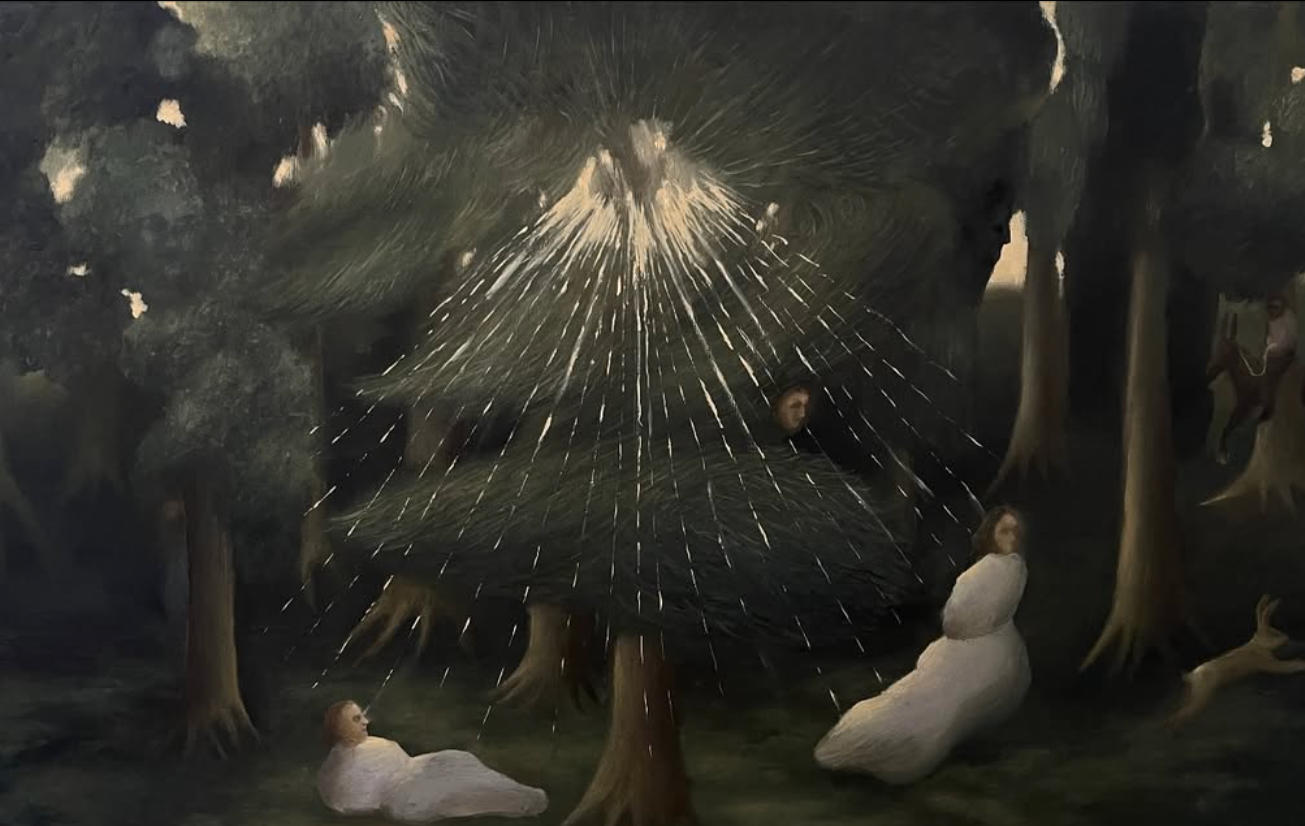
2025, Gvozdeva. Photo courtesy of Gvozdeva.
What is your favourite piece of art that is not your own?
Now some of Munch works, I admire his feeling of composition, it very delicate.
What is your favourite piece of art that IS your own?
Yet to be created!
Has an art piece ever made you feel deep, profound, life-altering emotion? If so, what was it?
I’m sorry to answer music again. And many pieces that literally helped me not only to change or maintain some moods, but also life changing things. I think visual art can’t be that deep.
The GALERIE MERMAN mentioned in your profile: ‘In her artistic practice, Alisa finds her way into a specific state of consciousness, which can be defined as meditation.’ Does this mean that, for example, you sit down with your eyes closed and meditate on an idea for a piece of art you want to make? What does this meditative process look like for you?
Oh, I said this many years ago and I definitely changed my perception of the process. First of all I never practiced classical meditation, at that time just concentrating on painting seemed a very meditative practice to me. As for now, I understand how much I could think during the process and this is not meditative at all or I can just paint and go with the flow, that seems more likely to what I said but of course there are different moods. Though my preception of meditation also changed with years and now everything, the life itself is a meditation for me, or at least an attempt. So paradoxical but I don't refuse from these words.
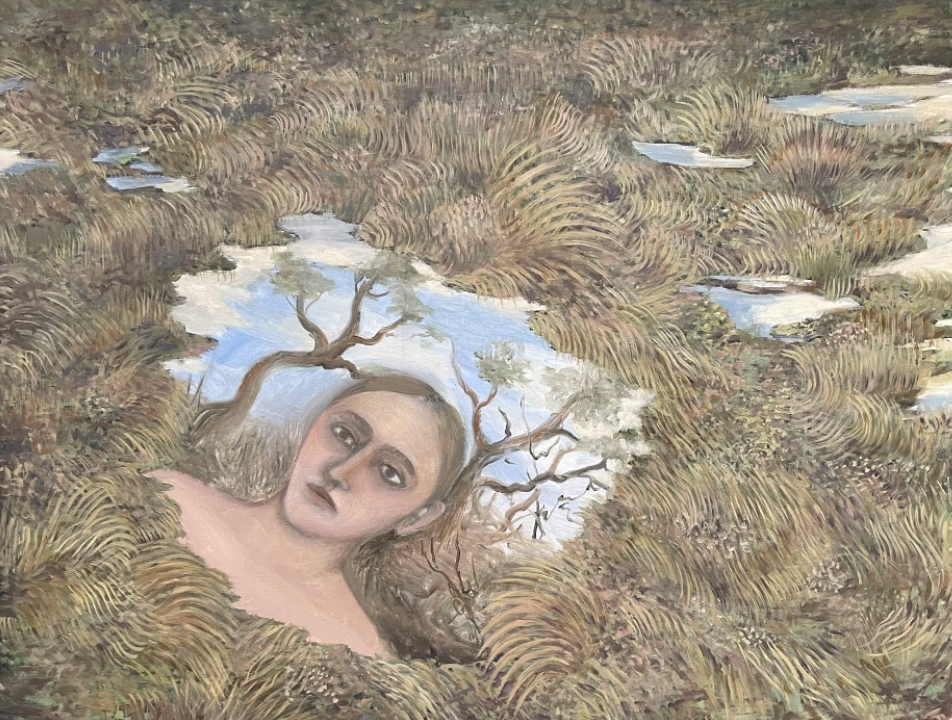
Reflection, Gvozdeva. Photo courtesy of Gvozdeva.
What led you to work with a gallery, and why specifically GALERIE MERMAN? When did you move to France and begin working there?
I used to work with many galleries in Russia, and a lot of things changed with my immigration. I’m glad that Anna Merman also once moved to France and invited me to this project. I like her taste, her approach to work, the true respect to artists and the artists of course.
As for my immigration, I moved from Russia because of war and I’m still trying to figure my life after that, last three years I spent here and there and I still don’t feel like really belonging somewhere, though you can find me in Paris.
You went to University in Russia and now live and work in Paris. What is a distinctive aspect of Russian-influenced art that you have noticed? What is a distinctive aspect of French-influenced art that you have noticed?
In my hometown I was very quickly accepted as an artist, every door was opened to me, here in Paris I feel unaccepted, there’s are so so so many artists in here and nothing works organic in this city. What I found in the system is the control of institutions, if you haven’t graduated from some respected university or collaborated with famous brand, you’re not recognised. The smaller institutions won’t accept you because the bigger didn’t. The whole European system of grants, residences, open calls creates a strange situation, where people around art, who likes to think, talk or network are getting sponsored, instead of those who really do art.
In Russia many artists are in prison for what they do, I think it’s nothing more to add.
Are there aspects of the Russian art world that you think the French art world could learn from? Are there aspects of the French art world you think the Russian art world could learn from?
As far as I know there’s not institutional education in fine arts, in classic academic techniques, which is really strong in Italy or in Russia. I personally never learned at academy, but when I look at contemporary Italian artist I truly admire their mastery. As for Russian art world, speaking about academy, the graduates are very strong skilled but they miss some kind of idea or soul, the individuality. I wish it could be more balance in art world, because I’m tired of seeing the pile of garbage in contemporary exhibitions in Europe alongside with very well realistic and skilled works from China or Russia, the both reds are silly.
Light and Shadow play significant roles in your work, and are really very softly blended, almost as if what you’re seeing may be sort of coated in a layer of mist or fog, or you’re seeing it through a very thin veil. This presentation of surrealist art, seeing an unconscious spiritual reality behind this veil, differs from some other surrealist art, like that of Dali, in which he used bold colours and dramatic delineations between light and dark. Have you always found your work to explore the surrealist effect in this softer way? Do you agree that your work has this effect?
Oh I never thought of it to be honest. I think it’s the effect of oil colours and how I explore it smoothnesses and softness. One may find oil very thick and use it differently, but for me it’s the way I feel that - I love when the edges of objects are merged with each other and also I’m really bad at light and shadow theory, so I’m really careful with it. I love the veil effect by the way and even planned an installation with many layers of it, I have poor eyesight and it’s literally how I see the reality especially objects in the distance, I think it’s also about my character, I think I’m a soft person.
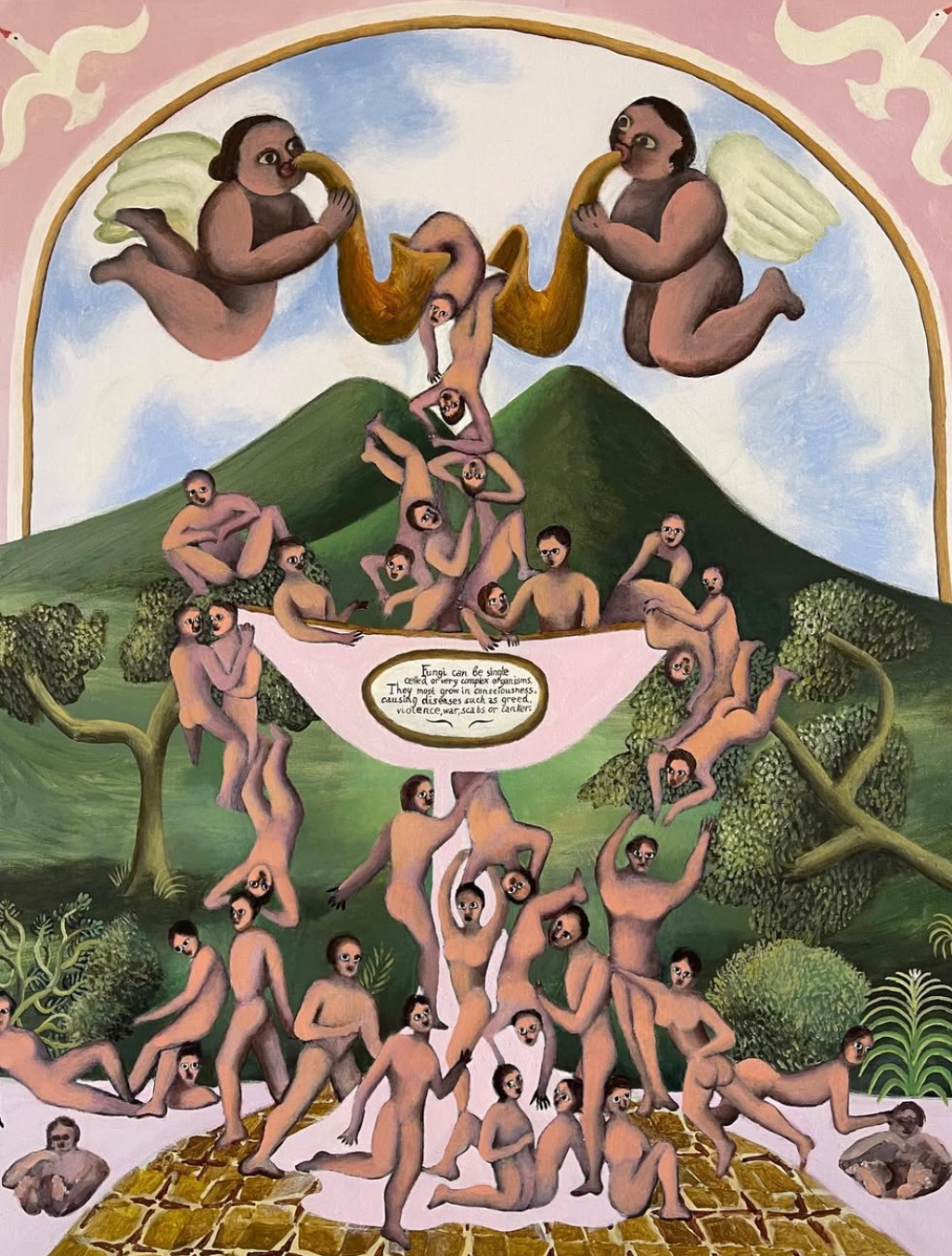
2023, Gvozdeva. Photo courtesy of Gvozdeva.
What medium of art do you think would be most frustrating for you personally to create in?
Embroidery!! because my back hurts after that, alongside with stone sculpture. But I still love both of this practice a lot.
Has a specific family member, friend, or person in your life significantly impacted your art career in a positive way? Who? How?
I always felt and feel the great support around my art, especially at the beginning when I only started to take it seriously about 10 years ago every family member, almost all of my friends supported me immediately even though I don’t think that works were really something. As about a career I’m forever grateful to Anna Naumova, who gave me the start as an artist by inviting me to Sample gallery. And also my favourite curator of all Peter Belyi, who is an artist himself and rules the Luda gallery in my hometown Saint Petersburg , I never felt so beloved in terms of my art and very well curating of my oeuvres, a true artist and a dream curator. I’m also really pleased with the fact that the other and really great cool artists bought my works, thank you my dearest colleagues!
What animal do you think you would be?
A frog, a pig or a rat, but I want to be a bird.
What is one piece of artistic advice you want to share?
Do what you can.
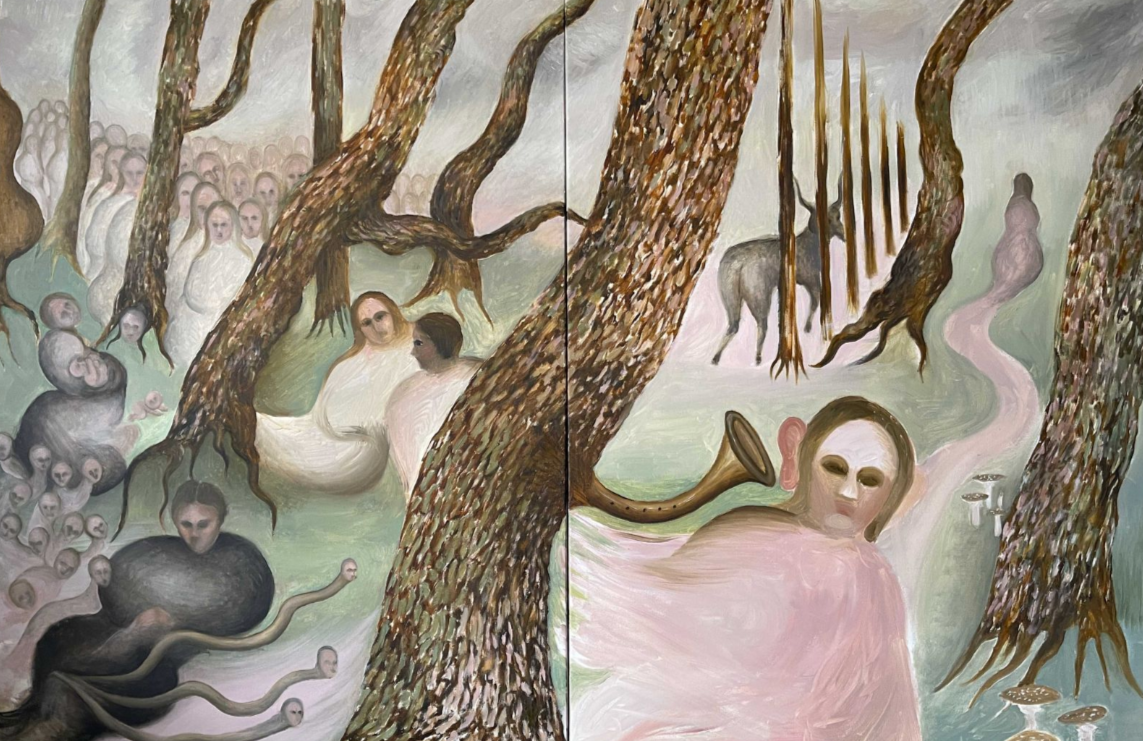
Untitled, Gvozdeva. Photo courtesy of Gvozdeva.
What is one piece of life advice you want to share ?
Same.
Is there someone in your life who has greatly guided you or supported you or inspired you in your artistic career ?
Yes my boyfriend Anton, he first asked me to do the design for cassette release for his music label. After that I started to paint a lot and appreciate it more.
If you had to have a non-art related job, what would it be ?
My mum once advised me to be a teeth sculptor, so I’m gonna go with that. I wanted to be a neuroscientist but I’m too irresponsible for that.
What do you love most about art?
It can change you in a good way, it’s magic, it makes you feel interested.
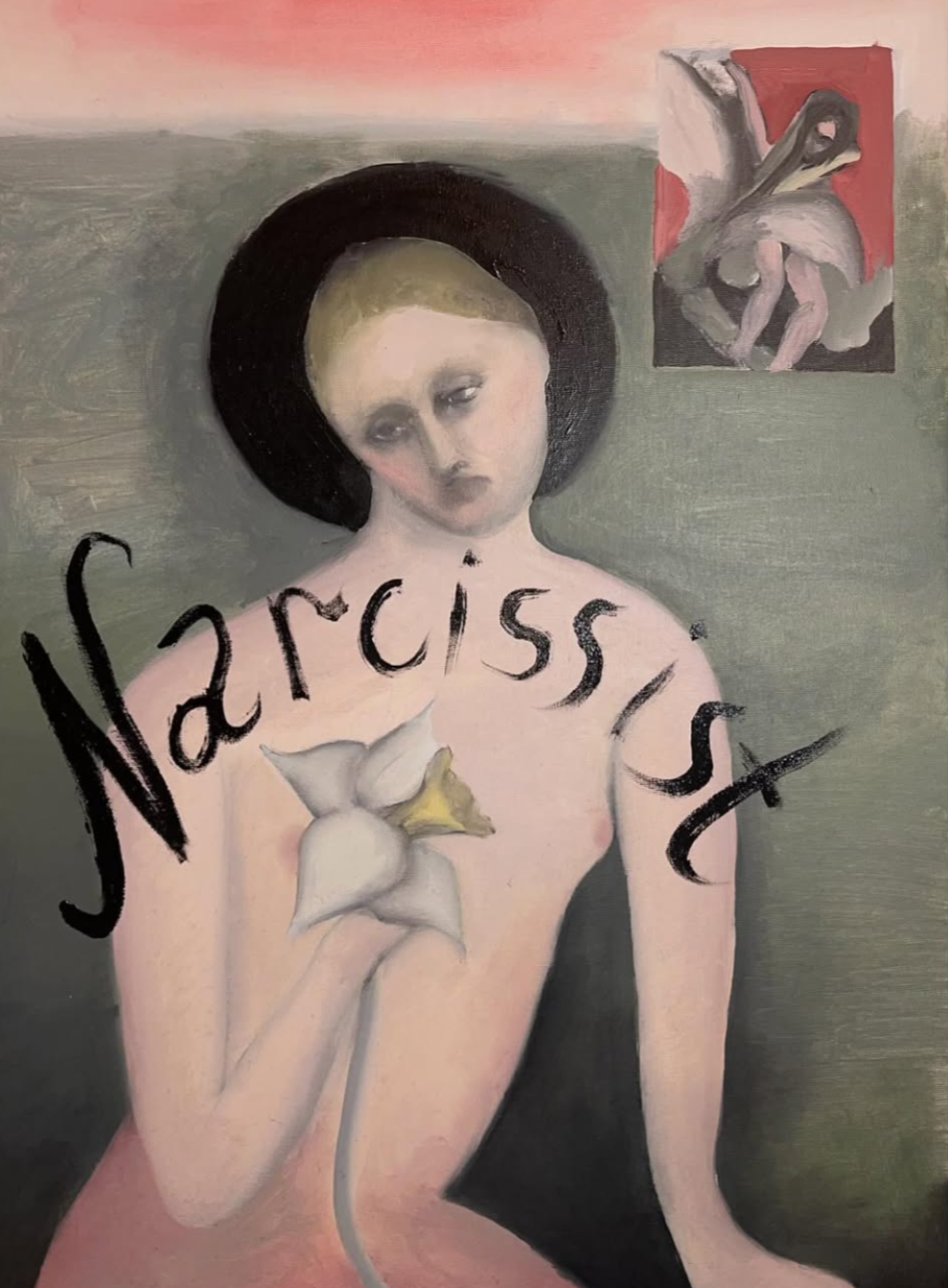
Narcissist, Gvozdeva. Photo courtesy of Gvozdeva.
Is there a museum, institution, gallery, etc. that you dream of one day showing your work in? Where is it? Why this place specifically?
I dream more about a strange and big projects, like painting in a church or sculpting for thermal baths or fountain. But I remember a strange feeling while visiting MOMA in New York when I was a teenager, I felt there that I want to be related.
Do you think art is important? Is so, why?
Music can literally change the vibrations of human body, first drawings of humanity were before the language appeared. I think art is in our roots, it was the first way of communication, rituals, traditions.
How can we make the art world better ?
Remember its sacred side.
What natural element do you relate to most? Air, fire, earth, water?
Water.
Interview by Eliza Palmer
ART ZAZA would like to thank Alisa Gvozdeva for her participation. Learn more about Gvozdeva on her Instagram, @vizhu.figu, and through her gallery, GALLERIE MERMAN.