Further information can be found on Louise Amel’s Instagram, @louise_amelll, and on her website, www.louiseamel.com .
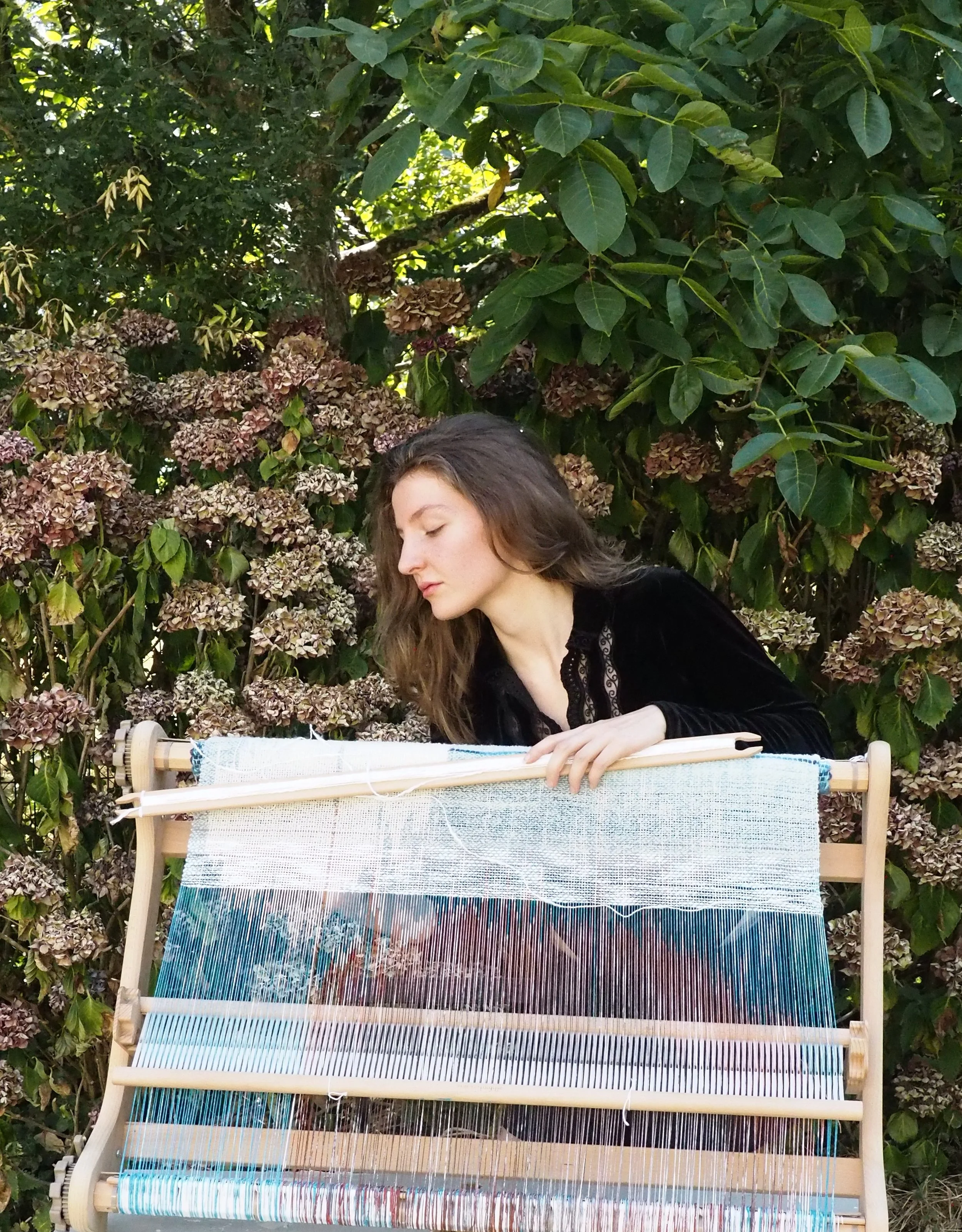
Louise Amel. Photo courtesy of Amel.
Deeply connected to the natural outer world and our natural inner worlds, Louise Amel, a multimedia artist from Marseille, weaves the emotional strings running through human life into tapestries telling of our perhaps fragile yet enduring lives. Amel brings found materials and reused fibres together to make her works, reflecting back to us and appreciating the image of our worlds.
What memory from your childhood do you think played a significant role in your development in the arts?
I was born in Tunisia, and I lived there until I was 4. Given the clear separation between the environments, I'm lucky to have very precise memories of my very early childhood, which I know was a difficult period for those around me. But also a wonderful one, and obviously full of discoveries given my age. I believe I've never stopped experimenting, trying to make connections -between places, objects, people-. I believe that one of the great richnesses of my construction as a person, and as an artist, is having grown up in a blended family. Being surrounded by children throughout my childhood, within the home (I was the youngest in one house, and one of the oldest in the other), is fertile ground for imagination, human connection and our relationship to space and materials. It's hard to choose one particular memory; I think of the magic mixtures made of earth, water and pebbles, of the invented character of the Bird, who came to visit my little brother and pass him secret messages to follow a treasure hunt, the huts... Of course, dance has played an immense role in my life so far. It too has nourished my relationship to others, to movement, to the plasticity of gestures, space, rhythm.
How do you go about beginning the process of creating a work of art? What is the first step?
At the beginning there was a long journey to find my own means of expression. I used to paint a lot with oil on canvas, and when I discovered weaving with Jamila (a Moroccan and Breton weaver), I fell in love with this practice. Everything it represents, and both the freedom and the framework it allows. After many experiments, I gradually had the idea of combining painting and weaving. I discovered that it created something very strong visually and sensorially speaking.
Today, the first practical step is to clearly define what form will be evoked on the weaving. Because I know that it will end up taking liberties that I don't necessarily plan, so I try to start with something fairly clear at the beginning. Of course, if we're talking about the very very first step, the one of inspiration, it has been taking place within me forever, and it's a long and perpetual journey before I consciously decide to choose this poem, this family photo or this postcard collected by my mother.
You mentioned on your Instagram that your mother used to say you were like a magpie - always attracted to anything shiny. I really relate to this - I have always loved all things glowy, shiny, sparkly. My bachelor's degree dissertation was specifically about why people are attracted to shiny things. Are there certain items or objects you have found that you remember really really getting attached to? If so, what were they?
Oh, what a fascinating subject! I would be very curious to hear about your research on this phenomenon.
Yes, I picked up a lot of small objects or materials that I collected in a plush-shaped bag, but it was more a matter of collecting and ephemeral treasure than real long-term emotional attachment (even though I was still happy to come across these little relics again after long months of forgetting them). But there is something that kept recurring and that I considered even more precious: all the finds that came from or were transformed by the sea (shells, polished pieces of glass, pebbles...). Indeed, I remember that yellow tin of cocoa powder that held my most precious pebbles. Of course, not just any ones. They had a pure shine, with shiny particles, like glitter. Despite the weight that this kind of treasure imposed, it was absolutely imperative to steal them from nature to bring them into my intimate space. Often, I would open the box to contemplate my relics.
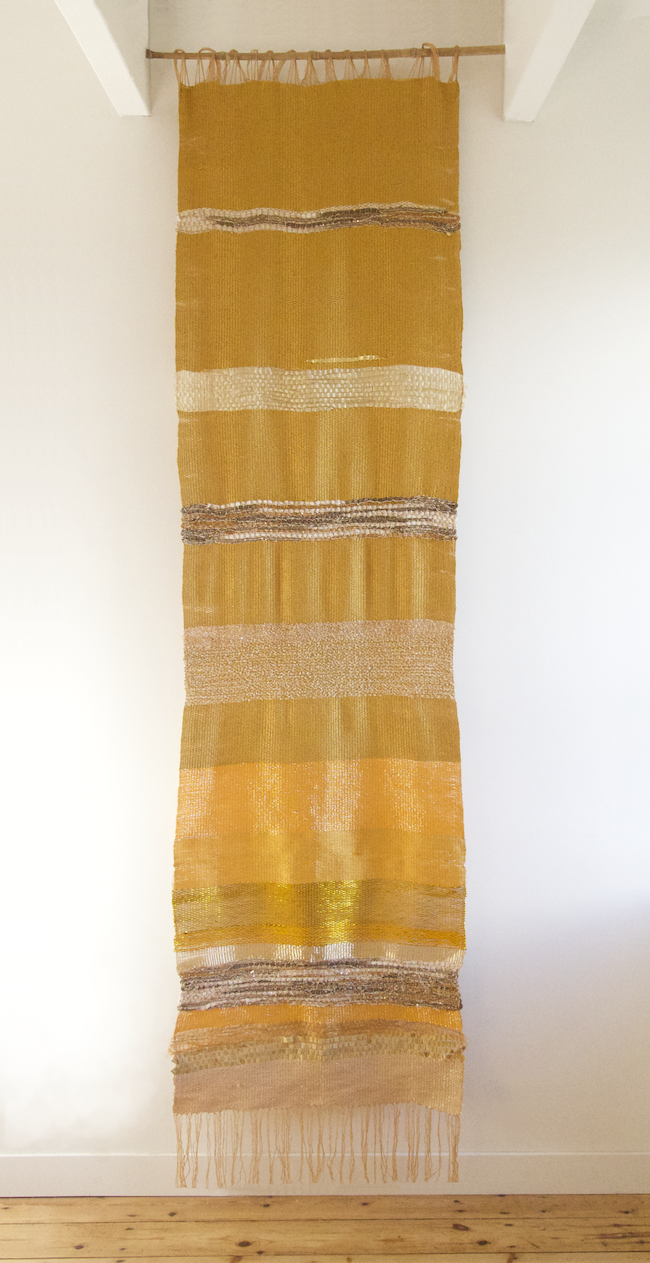
Dorée - The Magpie Series, 2026. Amel. Photo courtesy of Amel.
If you don't use things you find in nature for your weaving, what else do you make or do with them?
It's true that I experimented a lot with materials I found in nature to integrate them into my weavings. Today I still gather when it's stronger than me, and these finds are part of my daily environment. They form little altars at my home, which reassure me with their presence. Otherwise, I often give the find to a loved one who shares the present moment, or as a sign of thought. I'm not saying it suits everyone to be burdened with a pebble or a shell, but at least in the moment the gesture of giving is another form of love language.
What emotions do you find make you more productive in terms of drawing? Do you think you draw more when you are angry, sad, or happy?
Since drawing is not my main means of expression (although it is part of it), I'm going to transpose this question to creation in general.
I'm rather someone who is driven by my emotions and positive states in creation. Sadness and anger tend to paralyze me, even though melancholy is a great breeding ground for me. Let's say that it is better able to give me intense emotions and to nourish my inner world. But when it comes to acting, to taking action, it's the positive, joyful moments, full of adrenaline (even though melancholy is not incompatible with, and is often mixed into, these positive moments). I need that to move forward, to evolve, otherwise it's a crisis.
What is your current favourite colour? Has this always been your favourite colour?
I would say it's green and blue (or a mix). I think it has always been a bit so, and there is often some yellow coming to brighten all of this up a little.
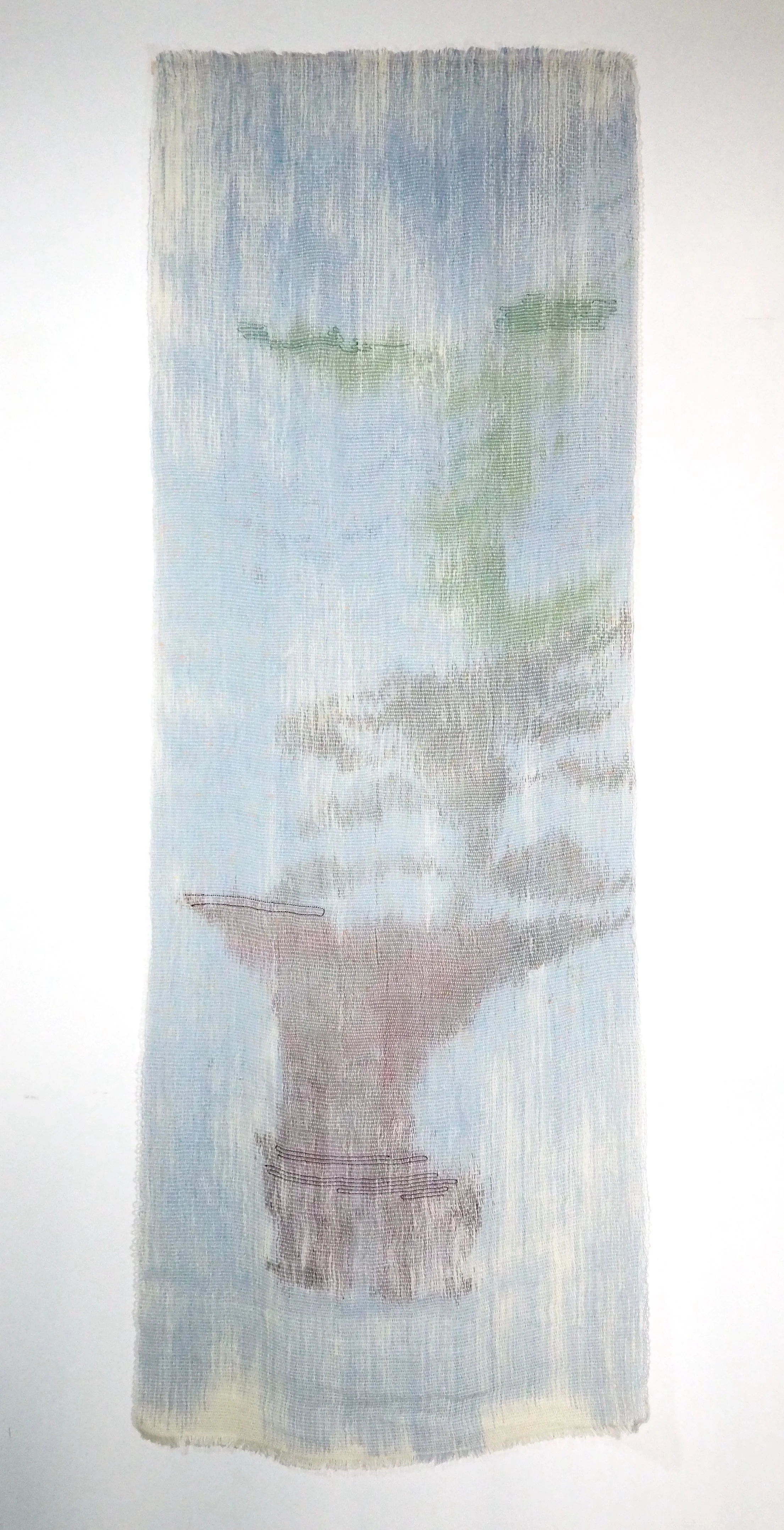
My Dearest Shadow. Amel. Photo courtesy of Amel.
What is your favourite medium of art?
I would say it's when I mix the medium of weaving with that of video (which was my gateway into the artistic world). In my opinion there is a link between weaving and video. It's a matter of rhythm, of point of view, there is an image that gradually reveals itself, that blurs. It's about stories, memories, the gaze (perhaps every form of creation in general, by the way, but these are part of my language, I've even mixed them at times).
What is your favourite piece of art that is not your own?
Very hard to choose! But what comes to mind right now is the dance piece Vollmond by the choreographer Pina Bausch. It's a piece with a lot of water.
What is your favourite piece of art that IS your own?
I think it's the one with two red/brown horse figures in a blue atmosphere. I believe it stands at the border between several elements that make me proud of it. Otherwise, an installation that was particularly stimulating was when I (as mentioned previously) mixed weaving with glass (I had blown glass rods), cotton, and video projection through this cotton.
Does creativity run in your family? Is your family also interested in the arts?
Yes of course, it's the most precious inheritance I carry. Even though I'm so far the only child who has taken this path professionally. My parents are both great creatives and we grew up immersed in discovering other people's art. And if we asked for more, they made sure we could have as much access to culture as possible.
Has a specific family member, friend, or person in your life significantly impacted your art career in a positive way? Who? How?
My mother has always pushed me and supported me to follow my instinct that guided me toward this path. And my best friend is the one who inspired me the most and followed me in my creative madness to experiment, always going all in and never judging. How many fits of laughter have we had? And my father gave me great freedom to be. My brother is the one who helped me most on the commercial side, to understand the stakes of the world we live in and try to find my place while staying aligned with what I convey, without getting crushed by the world. I consider myself so lucky for all this love and trust.
I really loved it when you said that "your style is built by trusting your choices". The message of this statement is so strong. It is rare an artist just stumbles upon their signature style, it is born out of practice and repetition and the small or big choices we make during each practice that eventually become our own style. Do you think that the people who see and collect your art can now identify your personal style?
Yes, I really believe so; the more I talk with wonderful people that I meet online or in physical life, the more I realize that all of them have a precise reading (whether in sensations or in putting it into words) of what I'm trying to capture through my artistic gesture.
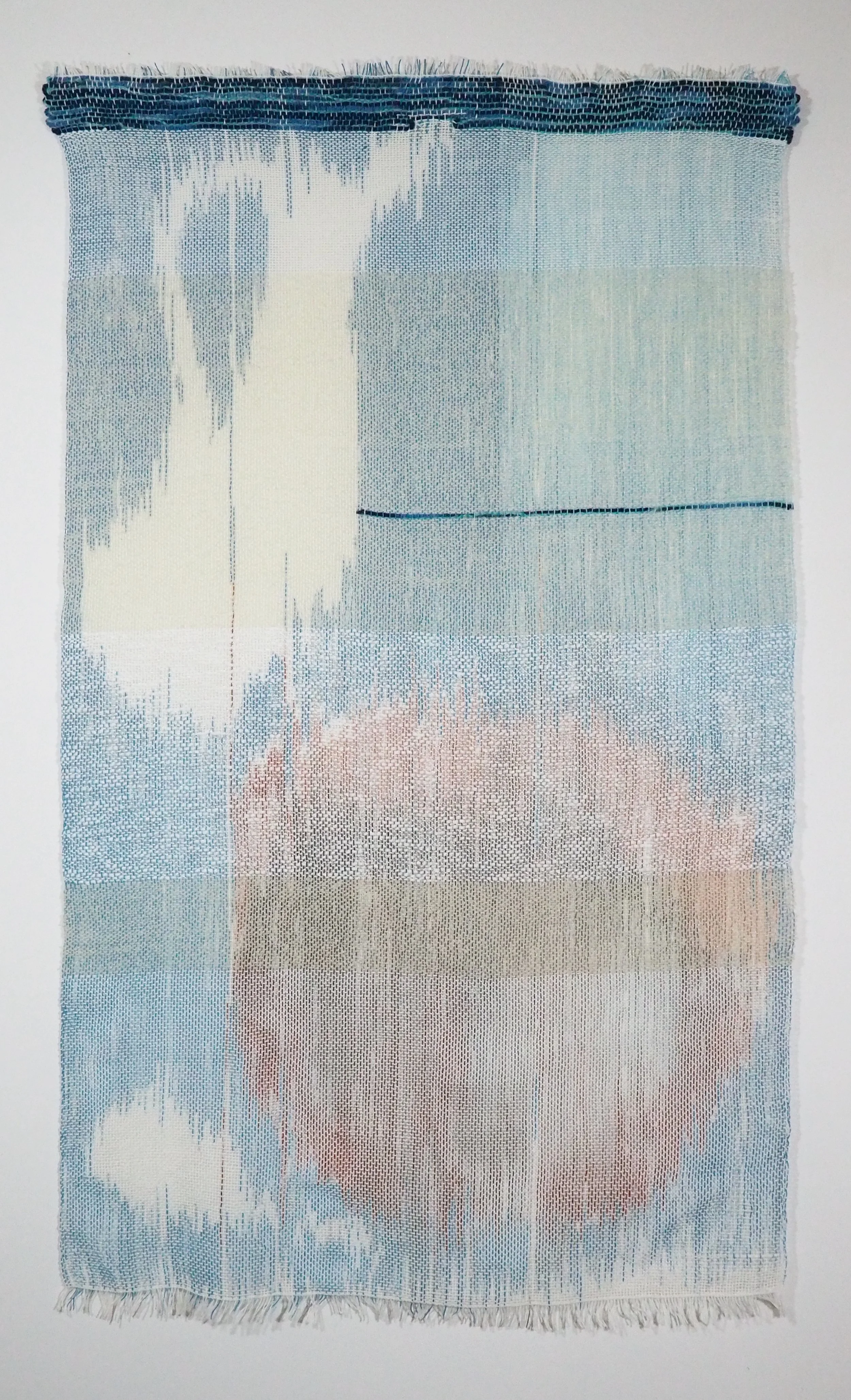
Lingering Shadows Series. Amel. Photo courtesy of Amel.
Does it matter to you if people can recognise your style?
Yes, because if they recognise this style and find themselves in it and are touched by a body of works, it's a very heady feeling that has to do with human connection. When someone writes to me and explains the reasons why they were touched by my work, I quickly understand that we're on the same wavelength, despite our differences and the physical distance. Like a common language.
Has an art piece ever made you feel a deep, profound, life-altering emotion? If so, what was it?
Yes of course, I think of Lynch's universe in general; I discovered it with his film Mulholland Drive. There is a scene that marked me for life, I stayed as if frozen in space-time when I discovered it, and every time I've watched it again. It's the scene that takes place in a theatre, a singer, with red and yellow makeup, a tear running down, sings "Llorando" a cappella, and collapses on stage. Visually, his universe made me grow and I fed on it a lot. It's as if I had found precisely this language, which I find difficult to put into words (I don't think I'm very good with words), in which it's about dreams, the psyche, inner upheavals and connections with others.
You mention on your Instagram that you enjoy reading. What genres do you enjoy reading in particular?
I read a lot of novels, contemporary or less so, almost exclusively written by women (I don't know if it's a choice but it's generally this kind of story that calls to me). Often it's about a strangeness that sets itself within everyday life; I can for example mention Truismes by Marie Darrieussecq, in which a woman gradually undergoes physical transformations over the course of the story. In reality she turns into a sow.
What is your all time favourite book?
It's Stone Butch Blues by Leslie Feinberg. This book moved me so much.
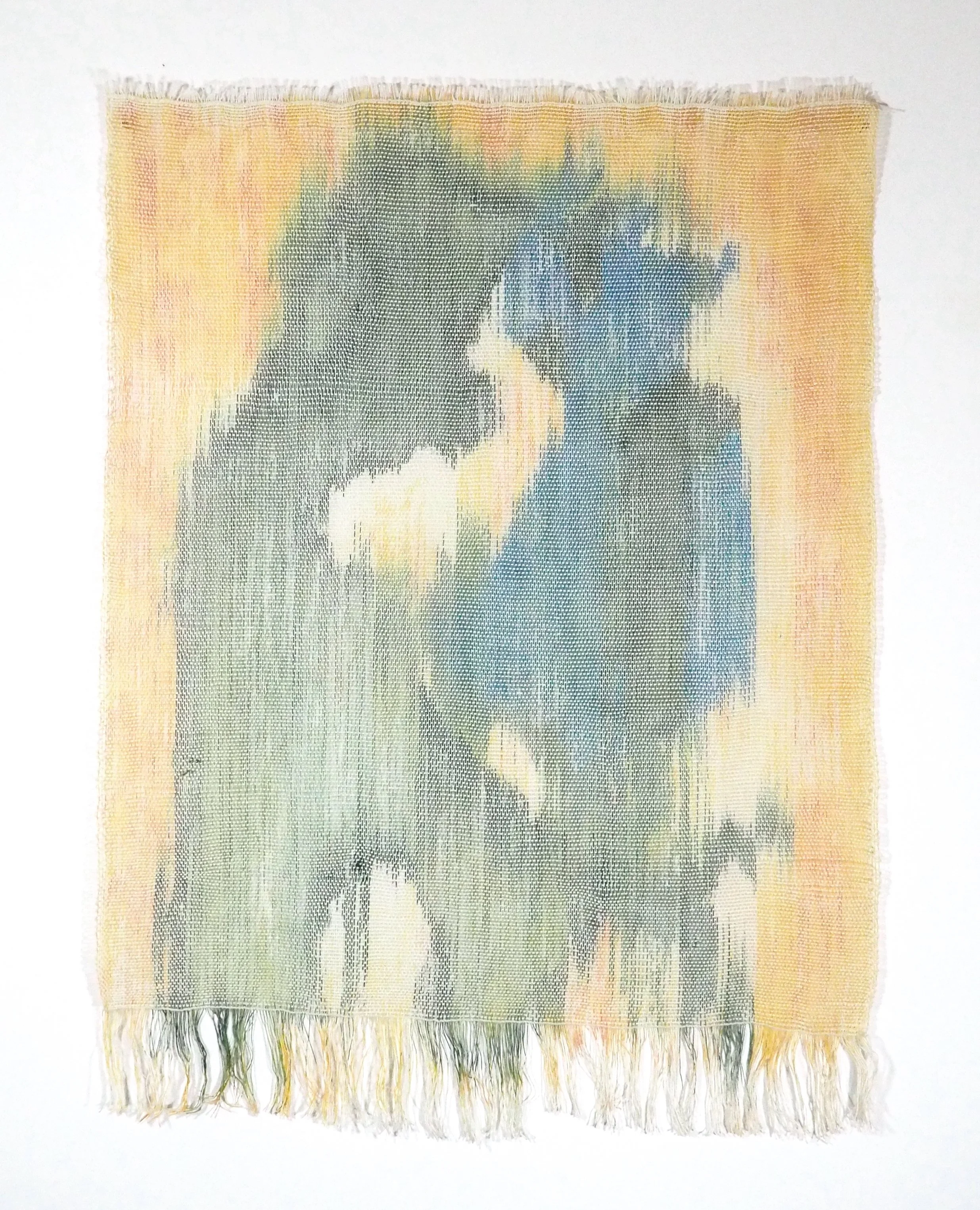
Lingering Shadows Series. Amel. Photo courtesy of Amel.
You say that you make pieces of art with a secret matrix - can you expand a bit about what you mean?
Of course, it's quite simple. I always keep the source of inspiration for each piece I make, whether it's a poem, an old postcard, a family photo... And when someone buys one of my pieces, I bequeath them the source of inspiration in an envelope sealed with wax, and the person decides to open it or to keep the mystery. I really like the little cerebral movement it can provoke, I wonder what everyone's imagination can create. It's as if it became a new virtual work.
You said that you discovered weaving years ago from a Moroccan woman weaver. Can you tell me a bit more about that experience?
It was almost a matter of chance. A few years earlier, my mother and I had seen her beautiful, colourful scarves, and she gave me a workshop as a gift. Jamila taught me to weave, and I fell in love with this practice. Being able to compose with colours, rhythms, textures, while being constrained and guided by the technique of weaving. That's where I started to find real freedom.
Is there someone in your life who has greatly guided you or supported you or inspired you in your artistic career?
There are several people, but if I had to name only one it would be my mother. I'm always amazed by the immensity of the trust she has in me, and by the precise understanding she has of my work, and of other people's work in general.
If you had to have a non-art related job, what would it be?
I would surely work as a librarian, even though I know it's a very difficult job.
What is one non-art related object that you will always have with you when you are working on your art?
A radio!
Is there a time of day or night you feel most creatively productive?
For ideas, it's in the evening before falling asleep. For physical, plastic work, it's in the morning and early afternoon.
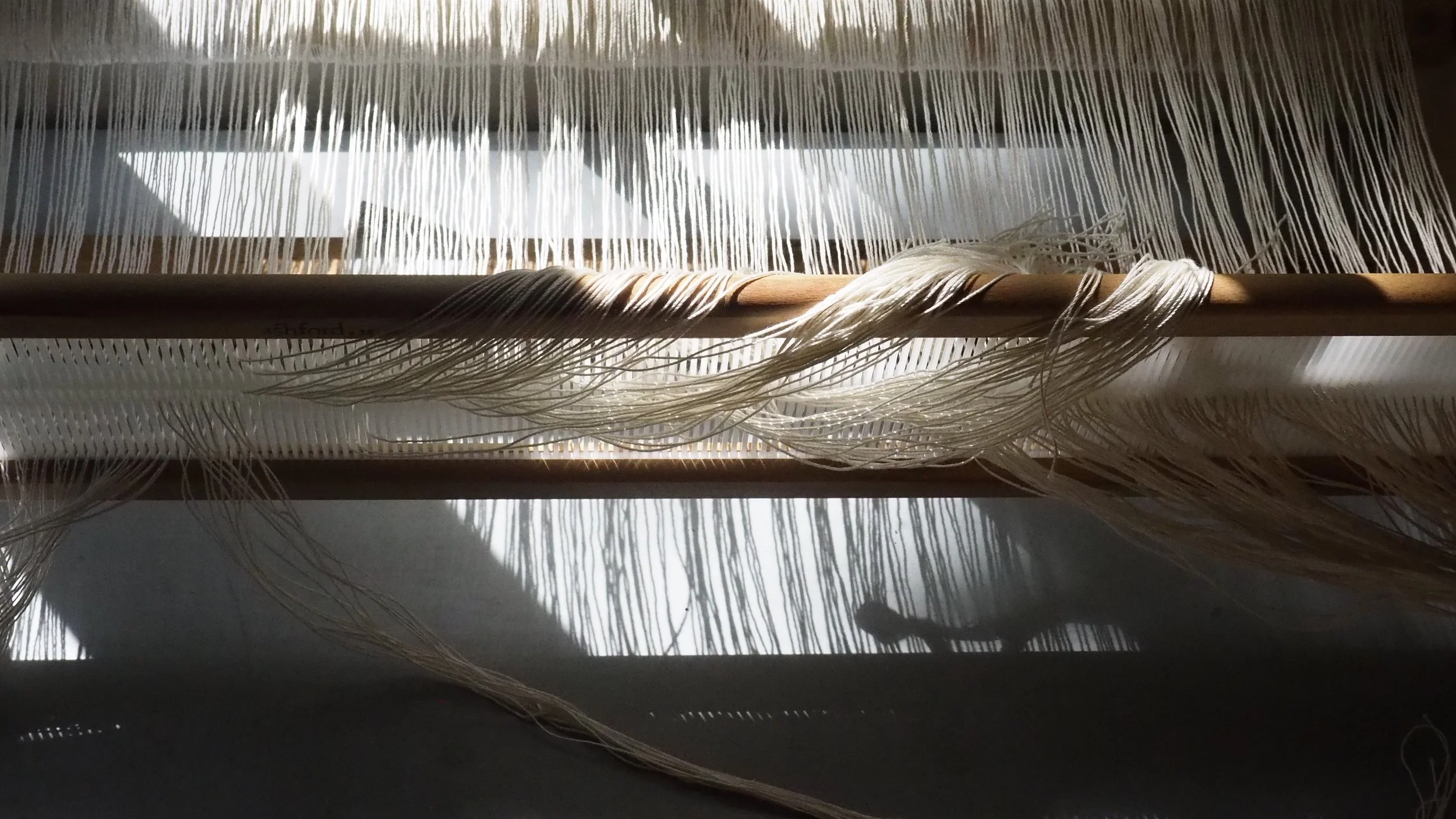
Weaving. Amel. Photo courtesy of Amel.
I really liked when you stated that you don't "force an image into a 'norm' because the fabric is alive, the paint is alive, I'm alive, and so is the piece." There is an acceptance of the unpredictable and the unknown. Do you carry this kind of radical acceptance in your life outside of art?
I have a great need for a framework, but a framework whose lines I choose. I'm very organized and I plan for every possible eventuality. If something unexpected happens, I believe I'm nonetheless open enough to work with it.
Would you describe yourself as a calm person?
Outwardly, extremely calm, but I'm a little pot at a boil on the inside.
You live and work in Marseille, France. Do you think there are qualities of your work or your practice that are very specific to the French style of art?
If I try to step back (I also asked someone close to me to answer this question), I would say there is something of the order of refinement, of the "decorative arts" dimension, combined with a freedom and a personal inspiration that makes me experiment with techniques, but also a rereading of art history through my intimate prism.
And also perhaps humour, offbeat playfulness: on several levels, for example weaving is a feminine art that has long been made invisible, and I give it back the status of canvas with the presence of painting, but also by sometimes drawing inspiration from the "masters".
What is one piece of artistic advice you want to share?
I think I still have a lot to learn, but I can share this thought: trust yourself when it comes to leaving the beaten path in terms of technique. Never stop experimenting, always consider yourself a child who discovers and explores matter, never consider a subject or a technique as being without new surprises or secrets for us.
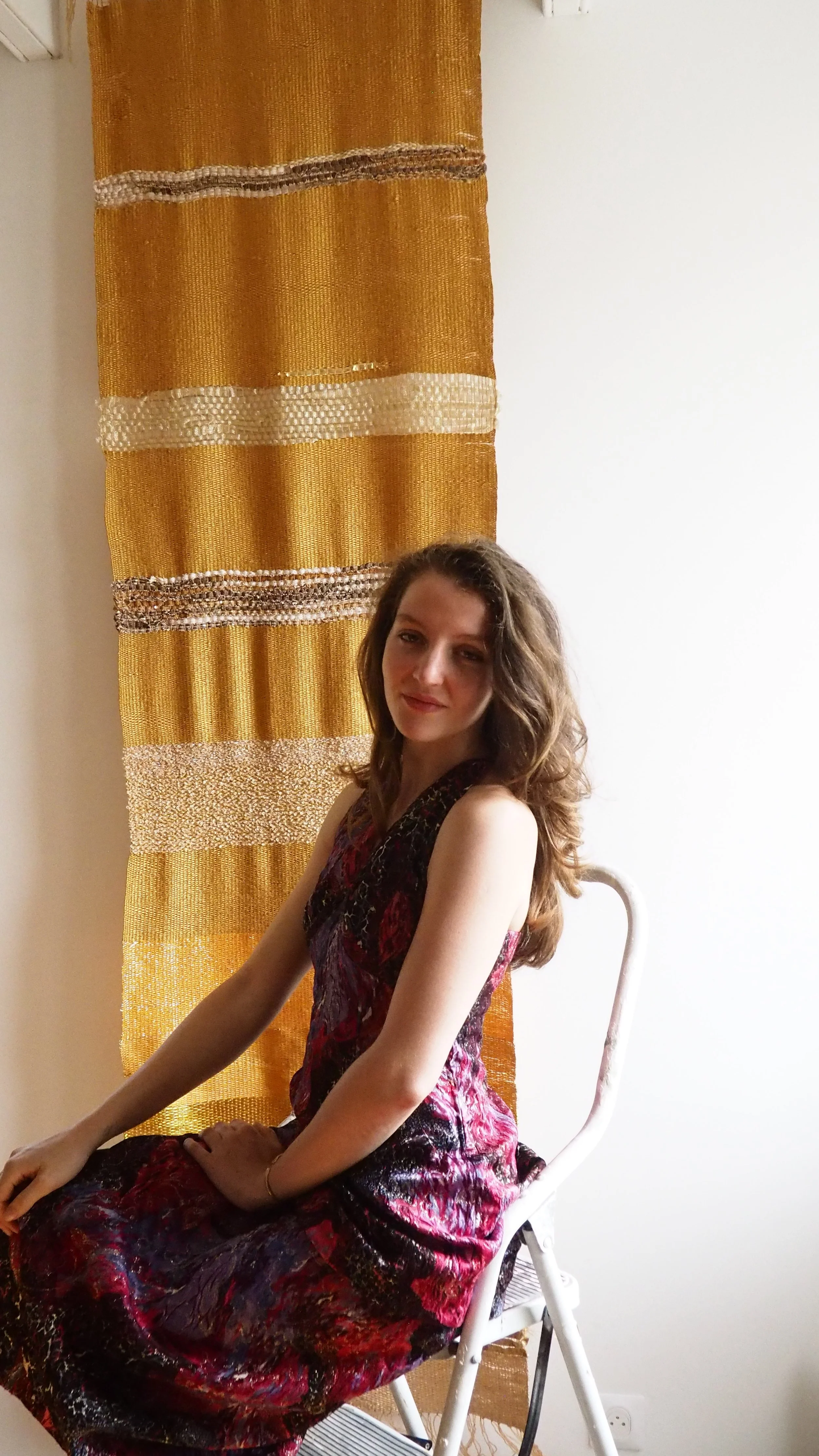
Louise Amel. Photo courtesy of Amel.
What is one piece of life advice you want to share?
It's a cliché, but what saves me day to day is my organization. And the more time goes by, the more I realize that everything is a matter of organization. Of course you have to manage to work with this organization, and leave room for an openness of mind that allows you to stay connected to the world, and to invite surprise.
What medium of art do you think would be most frustrating for you personally to create in?
Nail art would be extremely frustrating for me. It seems so difficult, making extremely precise drawings, with a sticky material, and having it look clean. I think that if I tried the experience it would look hideous haha, I don't know if it was the expected answer but it's what comes to mind.
What do you love most about art?
Human connections.
Do you think art is important? If so, why?
That’s for sure, without art our world would have no meaning, no reason to be. It's what allowed many periods, many people, to resist fascism. Yes, it's a form of resistance and a space for meeting, union, discussion. All of this is so precious.
I would also say that art is precious because artistic gestures are gestures that summon the mystery of being alive, the mystery of being human: it's what fascism most doesn't want us to start thinking about.
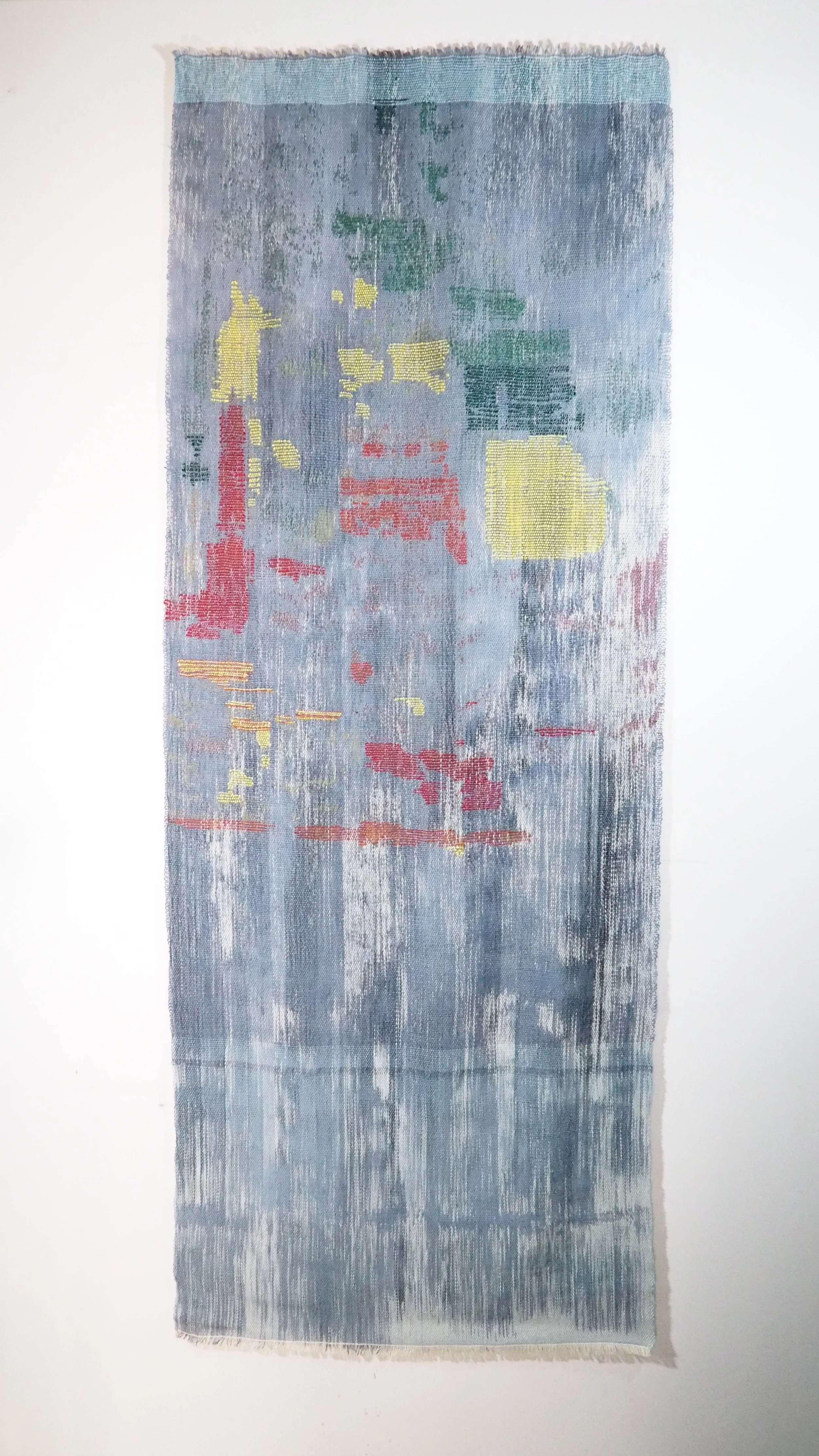
Lingering Shadows Series. Amel. Photo courtesy of Amel.
Is there a museum, institution, gallery, etc. that you dream of one day showing your work in? Where is it? Why this place specifically?
I would love to exhibit in NYC, and more particularly at Fridman Gallery. It's a gallery that gives real room to emerging artists, with space to experiment. My woven gesture would also find echoes there: several of the artists it shows work with textile, pattern or memory. My work stands between abstraction and representation, with images that appear without letting themselves be completely grasped, and it would fit naturally into this line. Finally, New York is close to my heart. As a young artist, I received an incredible welcome in the United States, and several of my pieces found their place there. Exhibiting there would be a beautiful way to extend this connection.
How can we make the art world better?
Vast question! Maybe precisely by considering artists as important beings for the functioning of our social, physical and spiritual world, and not just as a hobby, something "extra".
Also, I think of Van Gogh who died penniless, whose paintings sell for very high prices today. If that is indeed the question, there is a gap between the price at which some works sell and the precariousness of artists. For example, in France, demanding continuity of income for artists would be a real step forward.
What natural element do you relate to most? Air, fire, earth, water?
Water for inspiration, its movements, its sounds, its colours, and air for dreaming (I always have my head elsewhere, probably in the moon or the stars).
Interview by Eliza Palmer
ART ZAZA would like to thank Louise Amel for her participation. Learn more about Amel on her Instagram, @louise_amelll, and on her website, www.louiseamel.com .