Further information can be found on Marcelo A Rochá’s Instagram account @artrocha and on his website, www.marceloarocha.com.
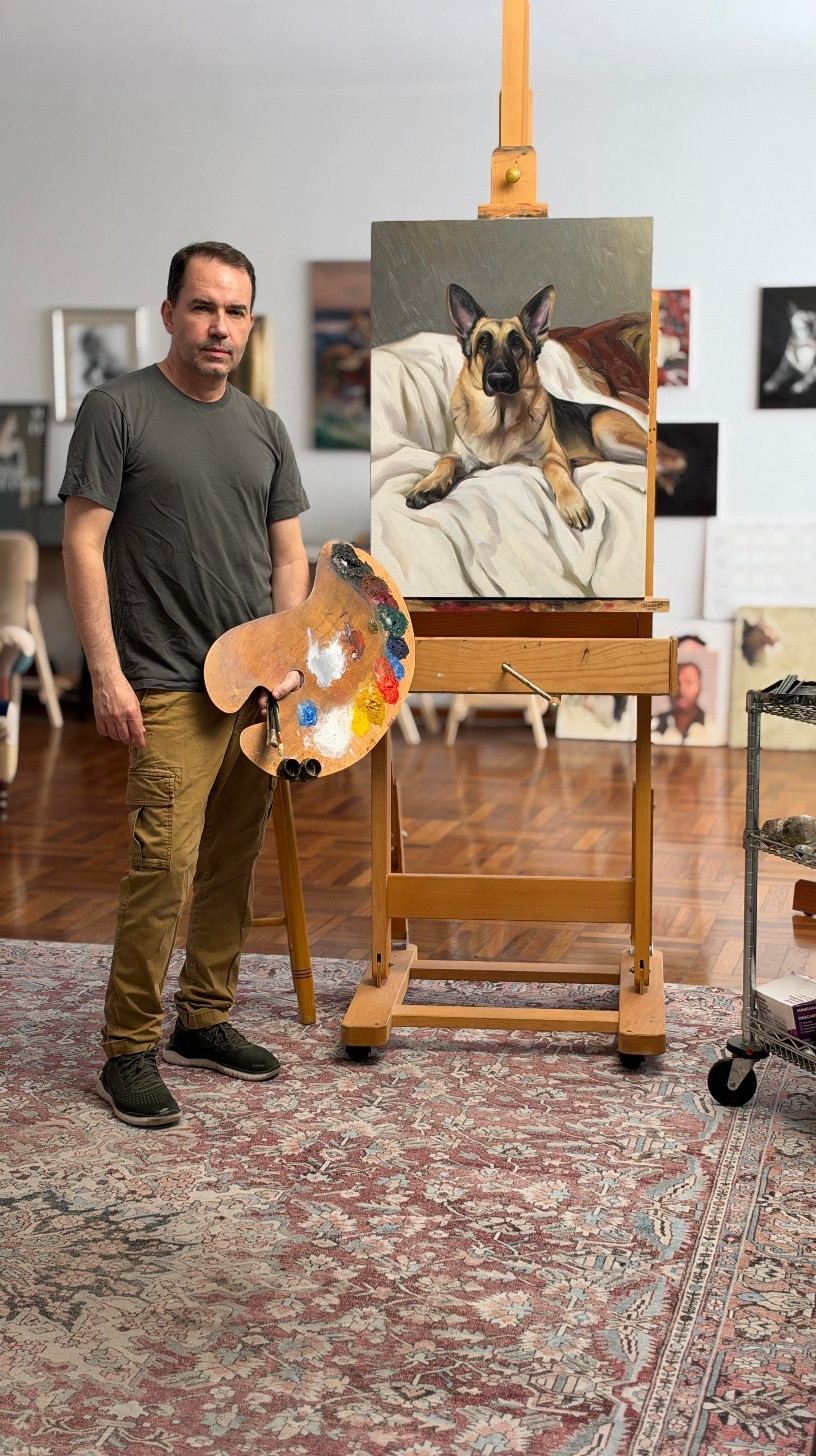
Marcelo A Rochá. Photo courtesy of Domestika.
Marcelo A Rochá is a Brazilian oil painter, specialising in portraiture of people and animals. After earning an MBA in IT Strategic Management and a 20-year career in information technology, Rochá began painting and studied in São Paulo, Brazil at the Pleinair Studio. Later, he studied at the esteemed Art Students League of New York. Rocha now not only creates moving portraits of people and animals, often beloved pets. He also runs an online course that has provided over 3500 students worldwide with a structured, method-driven approach to oil painting. We have the privilege to have learned more about this talented artist in our interview.
What was your ‘introduction’ to art?
My first contact with art was when I was very young. I enjoyed drawing cars and had notebooks filled with a few drawings, but that phase didn't last very long. Interestingly, I wasn't an especially artistic child. I went many years without doing any artistic activity before I eventually started painting.
You became an artist after decades of working in information technology. Why do you think you waited as long as you did? Was it more so out of necessity?
Art initially entered my life as a hobby. During my final years in IT, I was an executive working in a very stressful, high-pressure environment. I traveled frequently, especially to New York, where I always visited the Metropolitan Museum of Art. I was fascinated by oil paintings and began looking for an artistic hobby that could help me unwind and give me another focus outside work. I started learning oil painting through YouTube and Instagram videos, very casually at first. Later, I enrolled in an art school in São Paulo, and painting gradually became a much more important part of my life. Eventually, I was no longer very happy in my IT job, and I also wanted the experience of living abroad. That's when I decided to leave my career in IT and move to New York to study oil painting at The Art Students League of New York.
Do you think your skills learned from your background in Strategic Management have at all been incorporated into how you work now in your art practice?
Yes, in two main ways. First, my background helps me with research, testing, and experimentation in painting, whether I'm exploring materials or different approaches. I spent many years working in an IT laboratory, and I see some similarities between that environment and a painting studio: both involve constant investigation and experimentation. Second, my IT experience helps enormously with the digital side of my art career, including social media, websites, and promoting my online course. Technology feels very natural to me because of my previous career.
You studied art first in Sao Paolo, Brazil, and then continued your art education in New York, United States. What were some differences you noticed between studying art in Sao Paolo and New York?
I didn't notice a major difference in artistic references or philosophy. At Pleinair Studio in São Paulo, we studied and admired painters such as John Singer Sargent, Joaquín Sorolla, and Anders Zorn, often learning through studies and copies of their work. My teachers at The Art Students League, including Gregg Kreutz and John Varriano, were influenced by many of those same painters. That foundation helped me adapt very quickly in New York. There was, however, one major practical difference: at The Art Students League, we worked entirely from life, painting live models or still lifes rather than photographs.
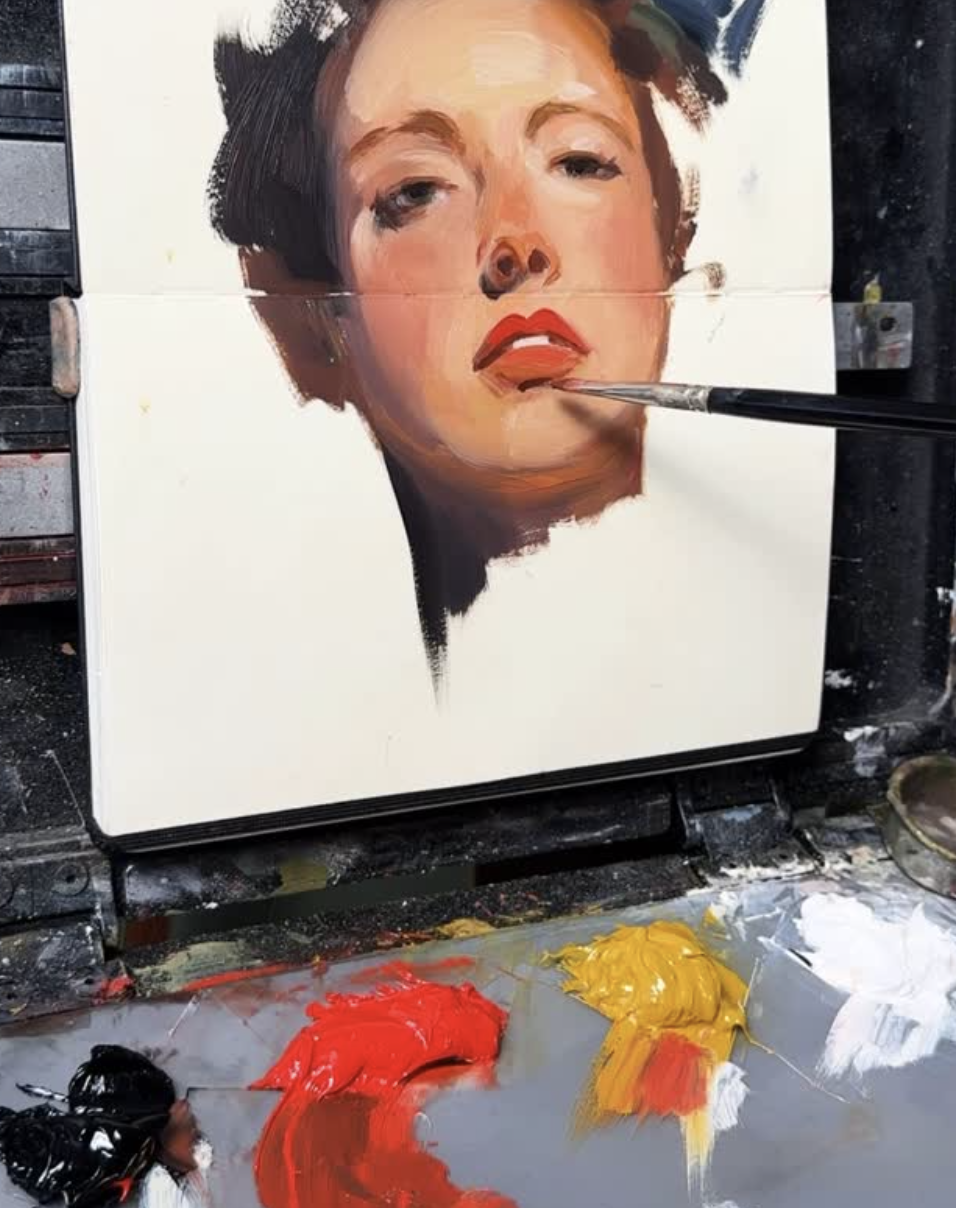
Still from oil painting process video. Rochá, 2025. Photo courtesy of Marcelo A Rochá.
Are there specific aspects of the Brazilian influence or American influence that have integrated into your practice?
I wouldn't say my work has a specifically Brazilian or American influence. My strongest influences come from nineteenth-century realist painters, particularly John Singer Sargent, Joaquín Sorolla, and Anders Zorn.
Do you have a personal preference for the education style in Sao Paolo or New York?
Although the artistic references were very similar, I preferred the approach at The Art Students League because we worked entirely from life. Painting a live model is a completely different experience from working from a photograph. It can be more difficult at first, but I don't think there's a better way to learn oil painting than observing real subjects, whether through figure painting, still life, or plein air painting.
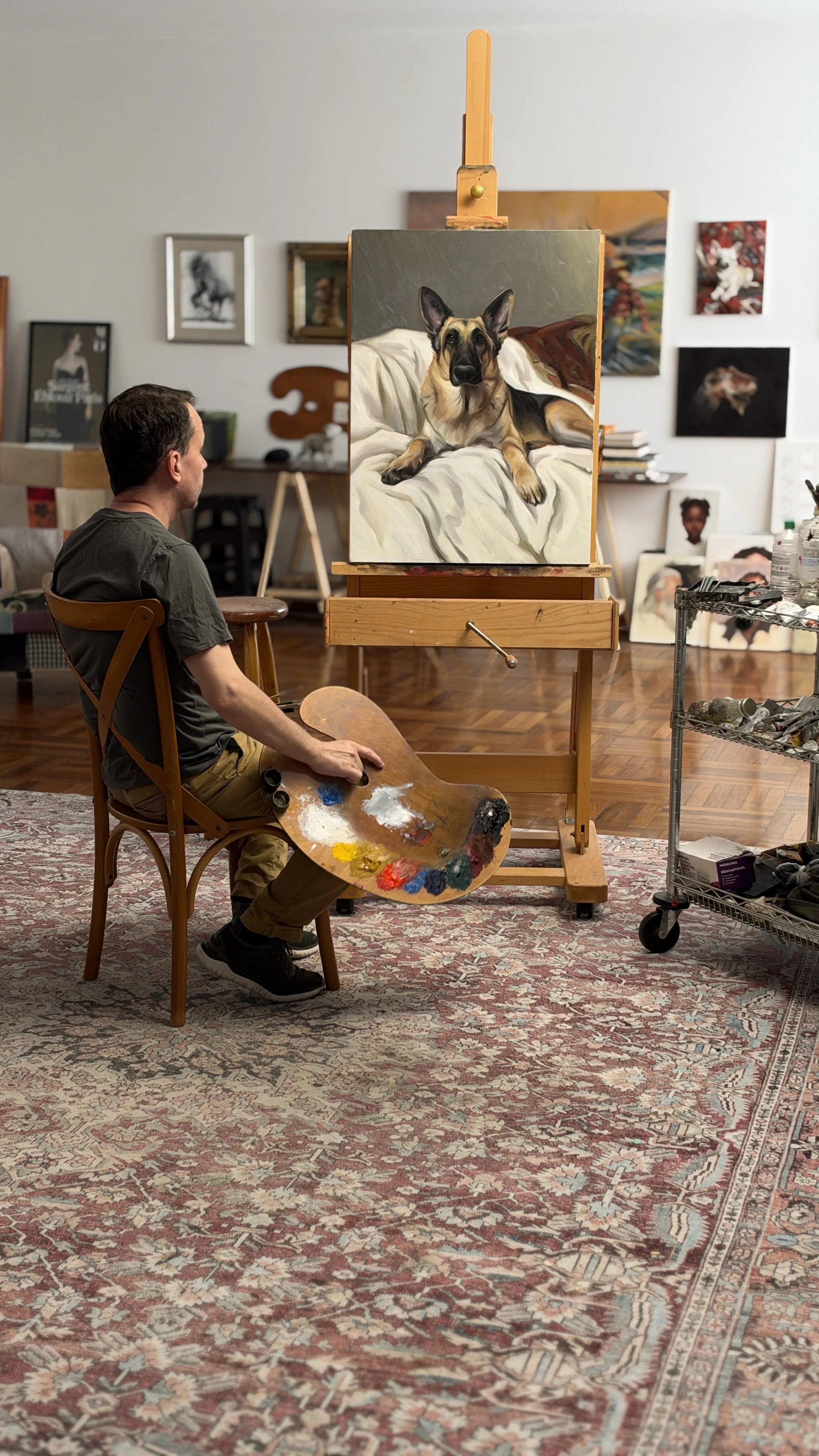
Marcelo A Rochá. Photo courtesy of Marcelo A Rochá.
What was something that scared or intimidated you about a career in the arts when you first started out?
I think it was the same concern that many artists have when they decide to pursue art professionally: whether I would be able to earn enough to support myself and continue doing this, and only this, for a living.
On your website in the About section, it says that in your work you focus on exploring ‘character presence’. What does ‘character presence’ mean to you?
For me, character presence means standing in front of a painting and somehow feeling the presence of the subject, whether it's a person, a landscape, or a pet. There are different ways to achieve that. The eyes, for example, can create a remarkable sense of presence when they're painted well. Another thing I've been exploring is painting pets at their actual size whenever possible. I've found that life-size paintings can make their presence feel much stronger. Many of the animals I paint have already passed away, and I believe an oil painting can be a powerful way of bringing a sense of their presence back into a home.
You have completed over 400 commissions that now live in collections in over 20 countries around the world. How did you begin your entry into commissioned work?
I've always had dogs and cats in my life. My first pet portrait was of my own dog, Sheik, a Brazilian Terrier who is now thirteen years old and is still with me. I happened to post the painting on Instagram, and people started asking whether I accepted commissions. That's how it all began.
Is there a commission brief that still stays with you today?
A recent commission that has stayed with me is a portrait of Sage, a German Shepherd. The painting is actually beside me as I answer this, waiting to be shipped this week. Because the client chose a large canvas and Sage was lying down in the reference photo, I was able to paint him almost life-size. That gave the painting a particularly strong sense of presence. For a long time, like many pet portrait painters, I used fairly abstract backgrounds that didn't represent a specific place. Over time, I began to feel that those backgrounds could sometimes make the animal seem a little isolated. Now I increasingly like to include familiar elements from a pet's everyday life, such as blankets, cushions, and sofas. These also make the composition more painterly and interesting. I find inspiration in the way painters like Sargent and Zorn used fabrics and clothing in their portraits, and I enjoy bringing a similar sensitivity to pet portraits.
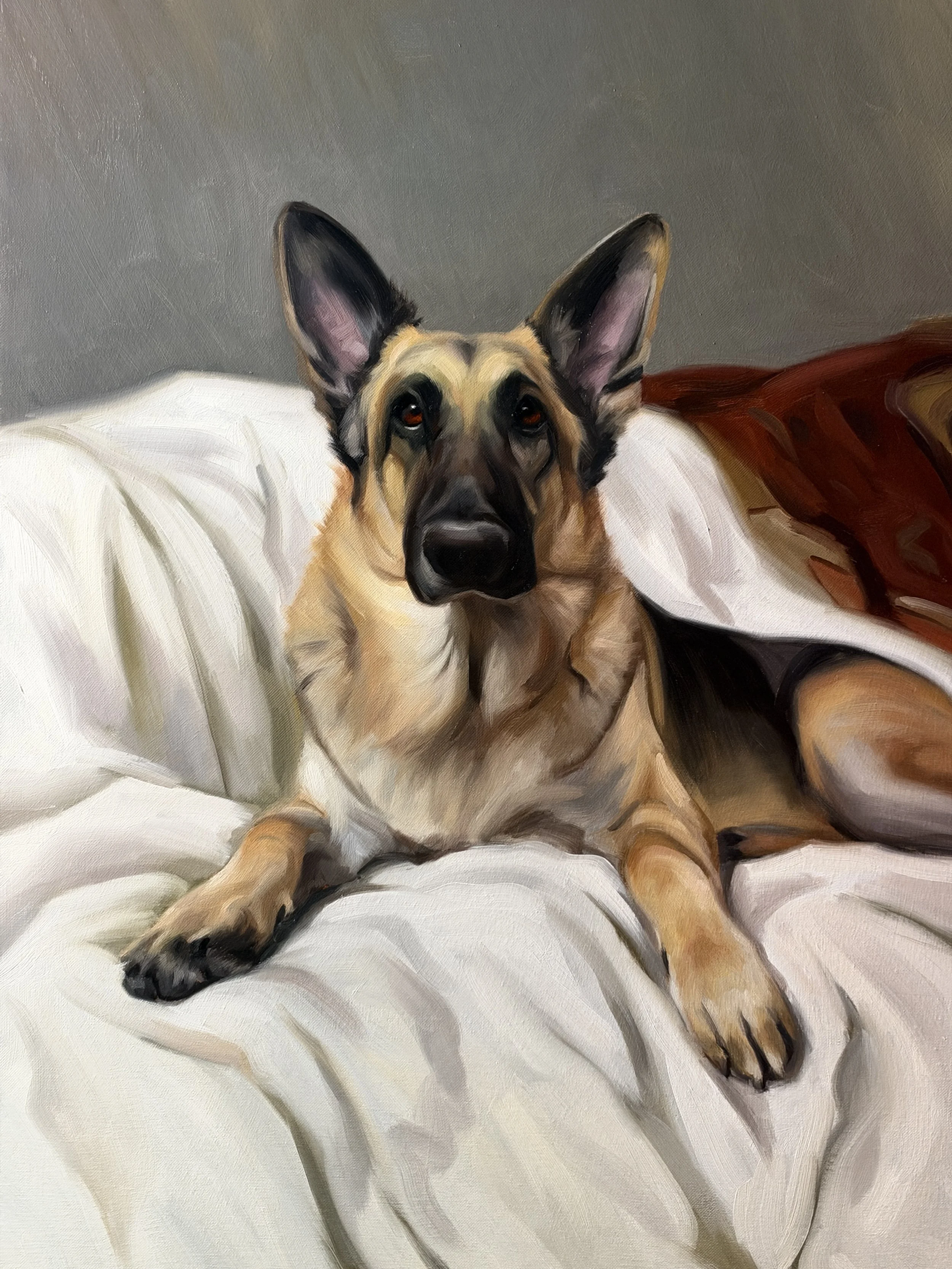
Commission of German Shepherd, Sage. Rochá, 2026. Photo courtesy of Marcelo A Rochá.
What would you say are the most common commission briefs you receive?
Most of my clients don't give me very specific instructions. They choose a canvas size and send me photographs, and I always encourage them to send as many as possible. I help select the reference that I think will work best for the composition. I don't usually send sketches for approval. I hope clients trust my artistic judgment and allow me to create something that surprises and delights them. After all, they came to me because they connected with the work they saw on my website or Instagram. For me, commissioning a painting is very much a relationship built on trust.
You currently have an online course to teach others how to approach oil painting. Why did you decide to go into teaching?
Beyond being a painter, I'm a real enthusiast of oil painting. I don't paint in other media, although I do make charcoal and pencil drawings as studies. I think oil painting is an extraordinary medium. I receive many questions from people interested in painting pets in oils, and many followers asked me to explain my process. Eventually, I decided to create a course to share my approach. There are countless ways to work in oil paint, and I myself use several different approaches, sometimes three within my practice. The course grew out of people's curiosity about how I paint.
Do you have a preference between teaching and doing your commissions?
My main activity is painting commissions. My online course is prerecorded, so students can watch the lessons at their own pace and send me questions, which I always answer. I occasionally give a workshop, but I don't teach regular weekly classes or have students coming to my studio. I'm a painter, and I believe my job is to keep painting, to paint more and to paint better. I enjoy sharing what I've learned, particularly through answering students' questions, but my main focus remains painting.
What is something valuable that teaching others has ended up teaching you?
Teaching has shown me how important the smallest details can be. When you paint every day, certain habits become so familiar that you barely notice them. But for a student, something that seems obvious or routine to me can be new and extremely valuable. It has reminded me that these seemingly simple things can have a significant impact on the final painting.
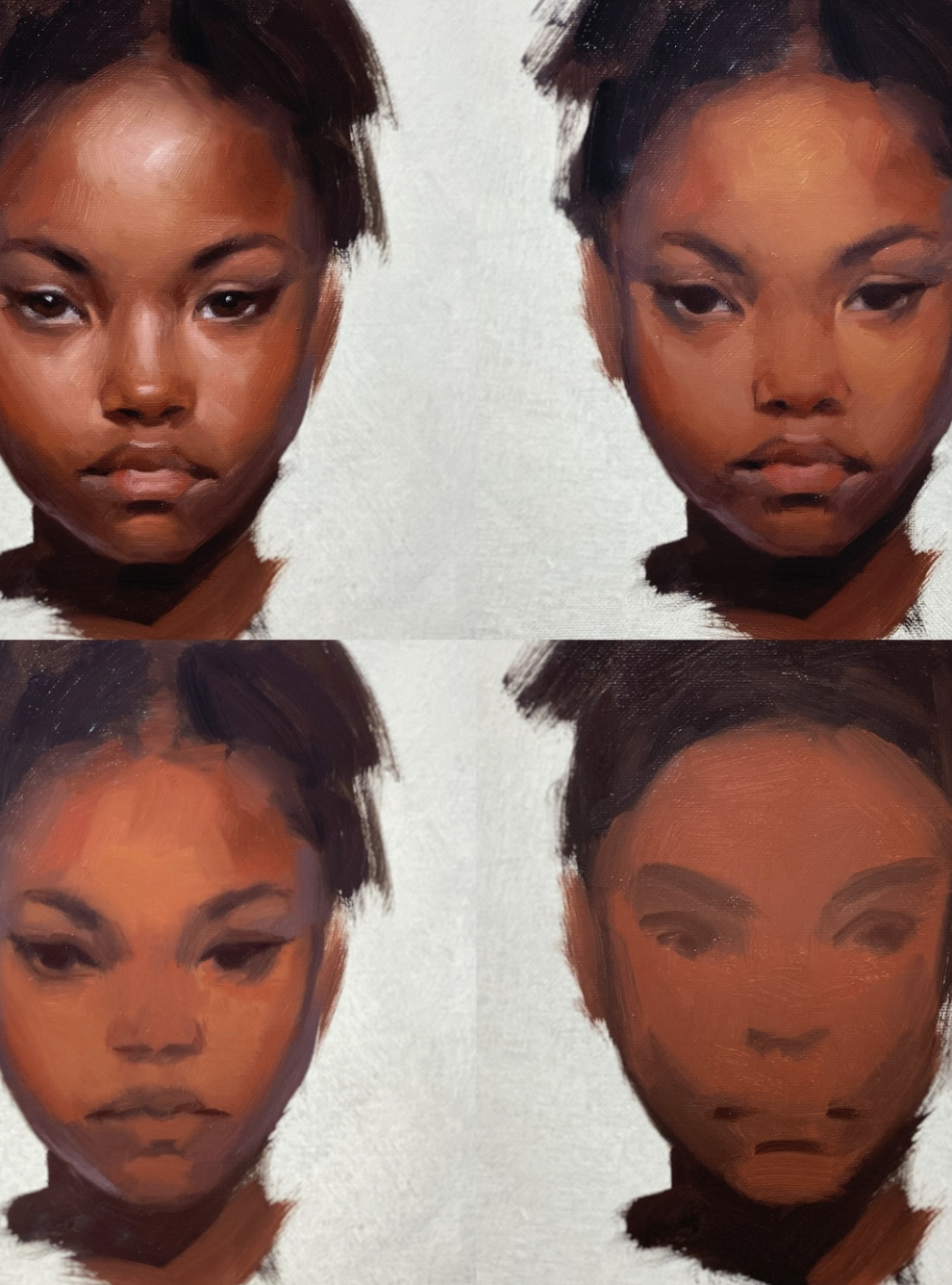
Portraiture process. Rochá, 2026. Photo courtesy of Marcelo A Rochá.
What would you say is the largest demographic amongst all of the students you have taught?
Most of my students are between 25 and 55 years old.
What other artists influence your work today?
My greatest influences remain nineteenth-century painters, especially John Singer Sargent, Joaquín Sorolla, and Anders Zorn. Earlier this month I visited the Metropolitan Museum of Art in New York, and the National Gallery of Art in Washington, D.C. Cecilia Beaux made a particularly strong impression on me. I also admire Rosa Bonheur and Ilya Repin. My references tend to return again and again to painters of that period.
What other artistic medium do you think you would find most fun to partake in for a day?
Sculpture, definitely.
Do you take a different approach to painting dogs versus cats, or do you paint different animals using different styles or techniques?
For cats, I tend to prefer softer brushes because their fur often has a finer, more delicate quality, and soft brushes help me express that. For dogs, I usually work with stiffer bristle brushes. I love using plenty of paint, and bristle brushes can carry a good amount of it while leaving visible brush marks on the canvas. Those marks can sometimes suggest the texture and direction of a dog's fur beautifully.
What is an essential non-art-related item you always have with you when you are making your work?
My studio journal. It's an unlined notebook where I write notes in pencil, rather than using it for sketches. As I mentioned, I used to work in an IT laboratory, and in some ways I think of my painting studio as a laboratory too, a place for constant testing and experimentation. I'm probably on my third or fourth journal now. I fill them with insights, ideas, discoveries, different approaches, and things I notice in the paintings I study. There's hardly a day when I don't write something in it.
What is your current favourite colour? Has this always been your favourite colour?
I don't really have a favorite color, but I do have a favorite palette: the limited palette associated with Anders Zorn, consisting of titanium white, yellow ochre, light cadmium red, and ivory black.
What is your favourite piece of art that is not your own?
Carnation, Lily, Lily, Rose by John Singer Sargent.
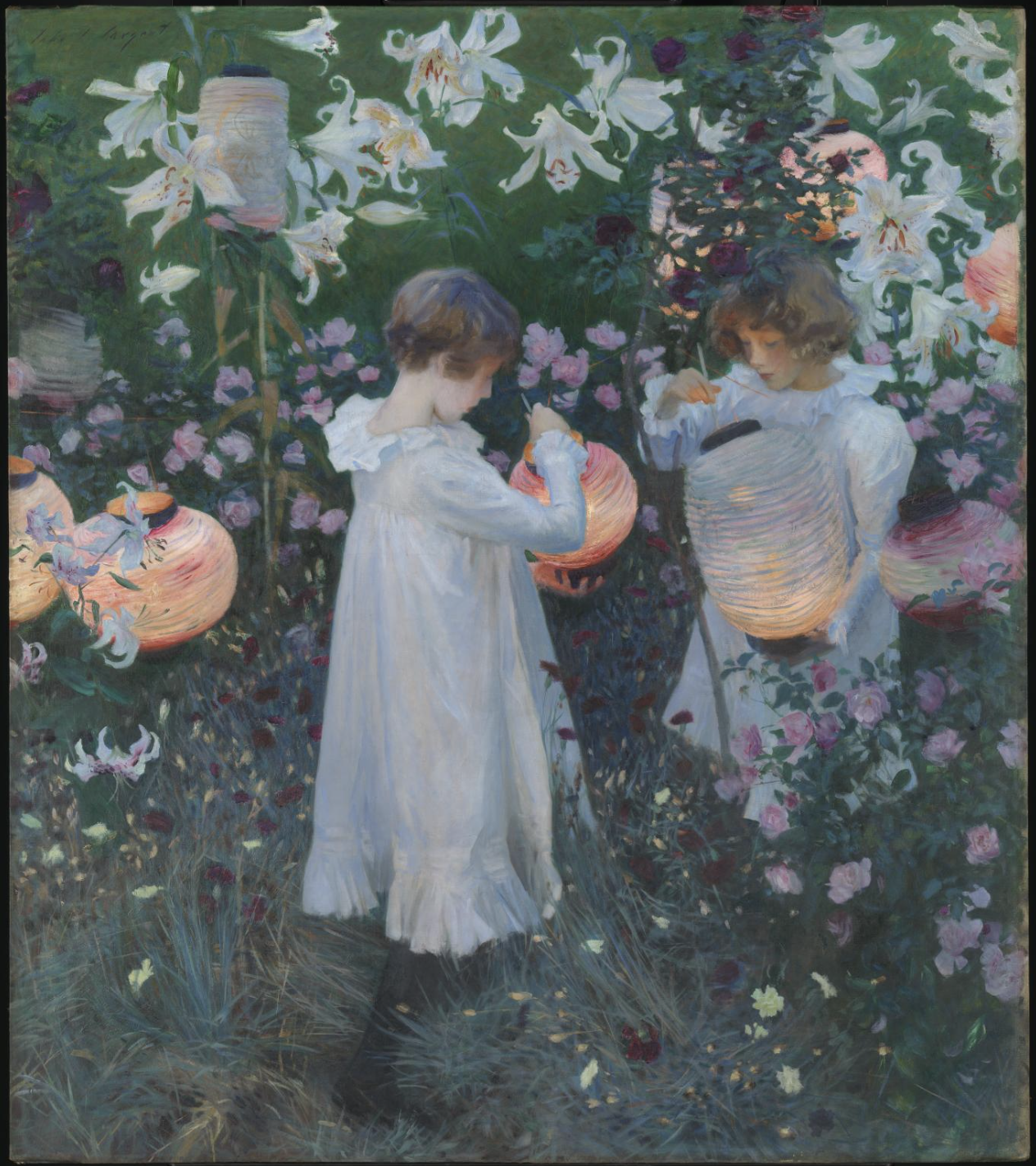
Carnation. Lily, Lily, Rose by John Singer Sargent, 1885-1886. Photo courtesy of TATE.
What is your favourite piece of art that is your own?
I often tell my wife, 'This is the best painting I've ever made,' and she laughs because I say that so often. But I genuinely feel that my work is constantly evolving, and that's exactly what I'm striving for: to paint more and to paint better. So my favorite paintings tend to be my most recent ones. Two that I particularly love right now are Maeby, a dog lying on a yellow sofa, and Sage, the German Shepherd I mentioned earlier.
Has an art piece ever made you feel deep, profound, life-altering emotion? If so, what was it?
Yes, very recently. Earlier this month, I visited the Metropolitan Museum of Art and encountered a portrait by Cecilia Beaux of a young boy dressed in red, Charles Townsend Ludington. I wasn't familiar with the painting before. It was displayed near works by Sargent in the American Wing, and it moved me deeply. It was certainly the painting that affected me most during that visit. In fact, before leaving New York, I returned to the Met specifically to see it one more time.
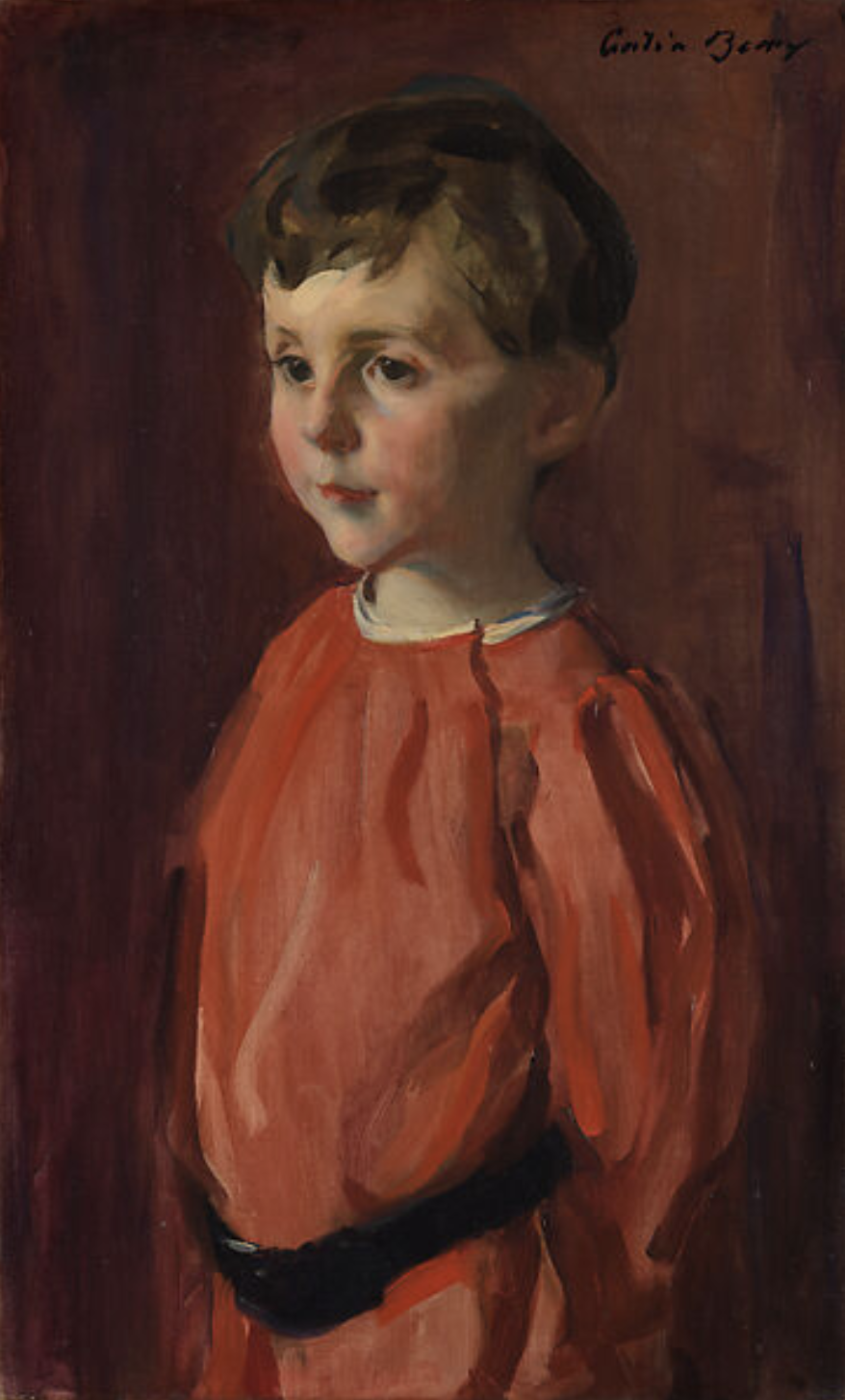
Charles Townsend Ludington by Cecilia Beaux, 1900. Photo courtesy of the MET.
What medium of art do you think would be most frustrating for you personally to create in?
I've never really thought about it, but I don't think any artistic medium would be frustrating for me. With practice, you always improve a little, and that continuous progress is enough to keep me deeply interested in the process. I tend to become extremely focused on whatever I'm learning, so it never really becomes frustrating.
Has a specific family member or friend or person in your life significantly impacted your art career in a positive way? Who? How?
Before I began painting, I didn't have any family members, friends, or relatives involved in art, so there wasn't a particular person in my life who introduced me to that world.
What is one piece of artistic advice you want to share?
Don't aspire to be self-taught. There's a certain romantic idea of the self-taught artist as someone who develops entirely alone, without being influenced by anyone else. I don't think that's really possible today. We're all influenced by what we see and learn. I'm not saying everyone needs formal training at a recognized art school. Studying other painters, watching demonstrations on YouTube, and learning different approaches are all forms of education. I think it's much more valuable to actively seek knowledge from other artists than to try to avoid influence.
What is one piece of life advice you want to share?
I can only speak from my own experience, and I don't know whether this advice applies to everyone. After twenty years in IT, I made the decision to leave that career completely and dedicate myself to something entirely different: oil painting. It was one of the best decisions of my life, and I'm grateful for it every day. I actually work much more now than I did in IT, seven days a week, but I'm so passionate about what I do that it hardly feels like work. It's an enormous pleasure.
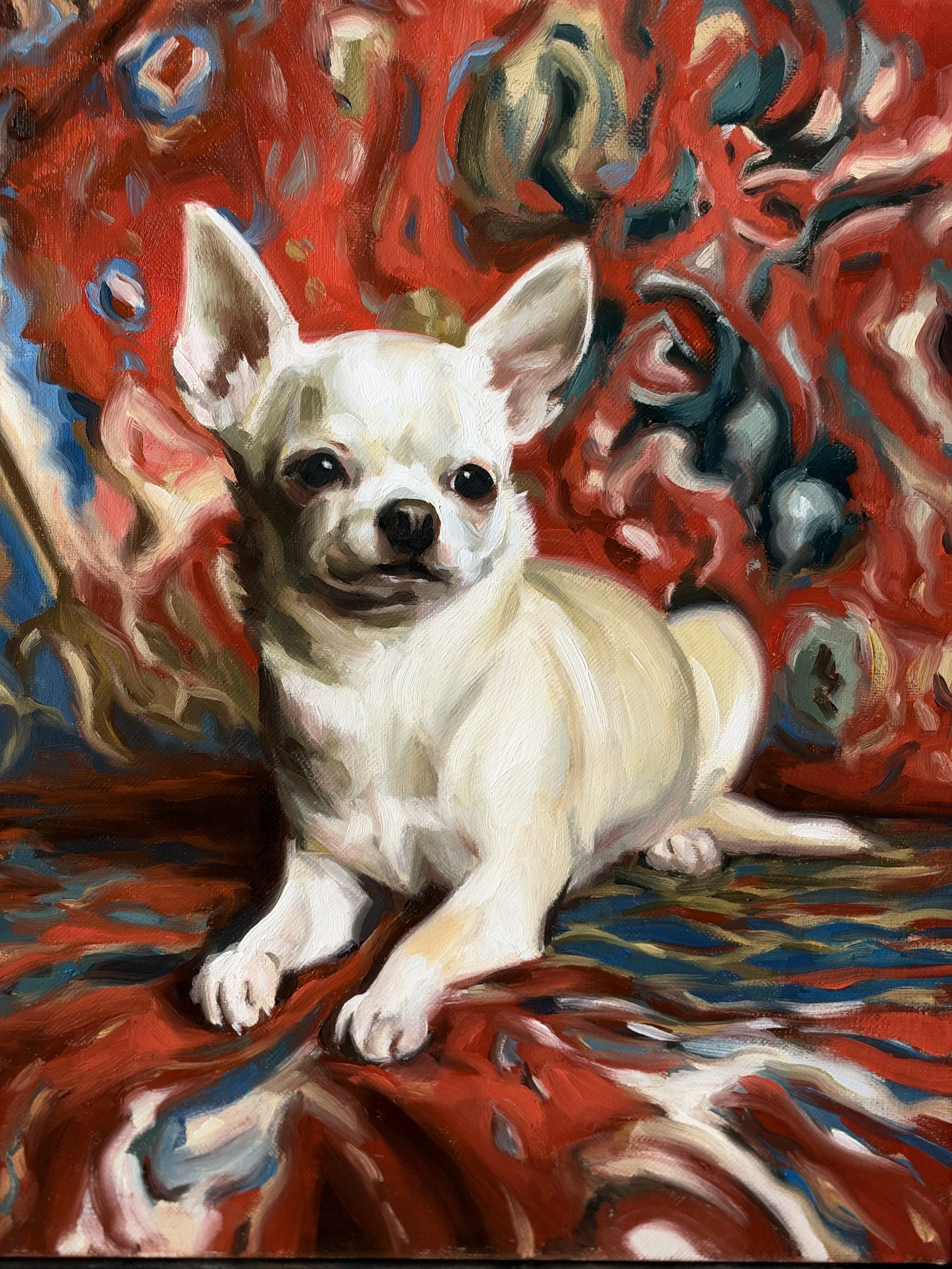
Commissioned pet portrait. Rochá, 2026. Photo courtesy of Marcelo A Rochá.
If you had to have a non-art related job, what would it be?
I've already had a career outside art, and now I have no interest in imagining another one. What I do today is what I want to do for the rest of my life.
What do you love most about art?
Freedom. The freedom to create what I want, with the intensity I want, and on the days I choose. Even though I work on commissions and paint other people's pets, I still have the freedom to interpret them through my own artistic identity and paint them in the way I believe works best.
What do you find most upsetting or frustrating about art?
One thing that really frustrates me, as someone who loves oil painting, is hearing people say that oil painting itself is toxic or that oil paint has a strong smell. Often, people are actually referring to solvents or to unsafe studio practices, rather than the paint itself. Some pigments and materials do require appropriate precautions, of course, but I think it's important to distinguish those risks rather than treating all oil painting as inherently dangerous. Misleading information can discourage people from trying this wonderful medium, and that really bothers me.
Do you think art is important?
Absolutely. I see proof of that in my own work. Sometimes a portrait I send to a client becomes one of the most meaningful reminders they have of a dog or cat who shared their life for many years. Oil paintings can last for centuries, so that image can remain with them throughout their lives and continue to preserve both a visual and an emotional memory of their pet.
If so, why do you think art is important?
For me, art has the power to preserve memories and emotions in a tangible form. A portrait can bring someone close to the presence of an animal they loved, even after that animal is gone. That's a deeply meaningful role for art to play.
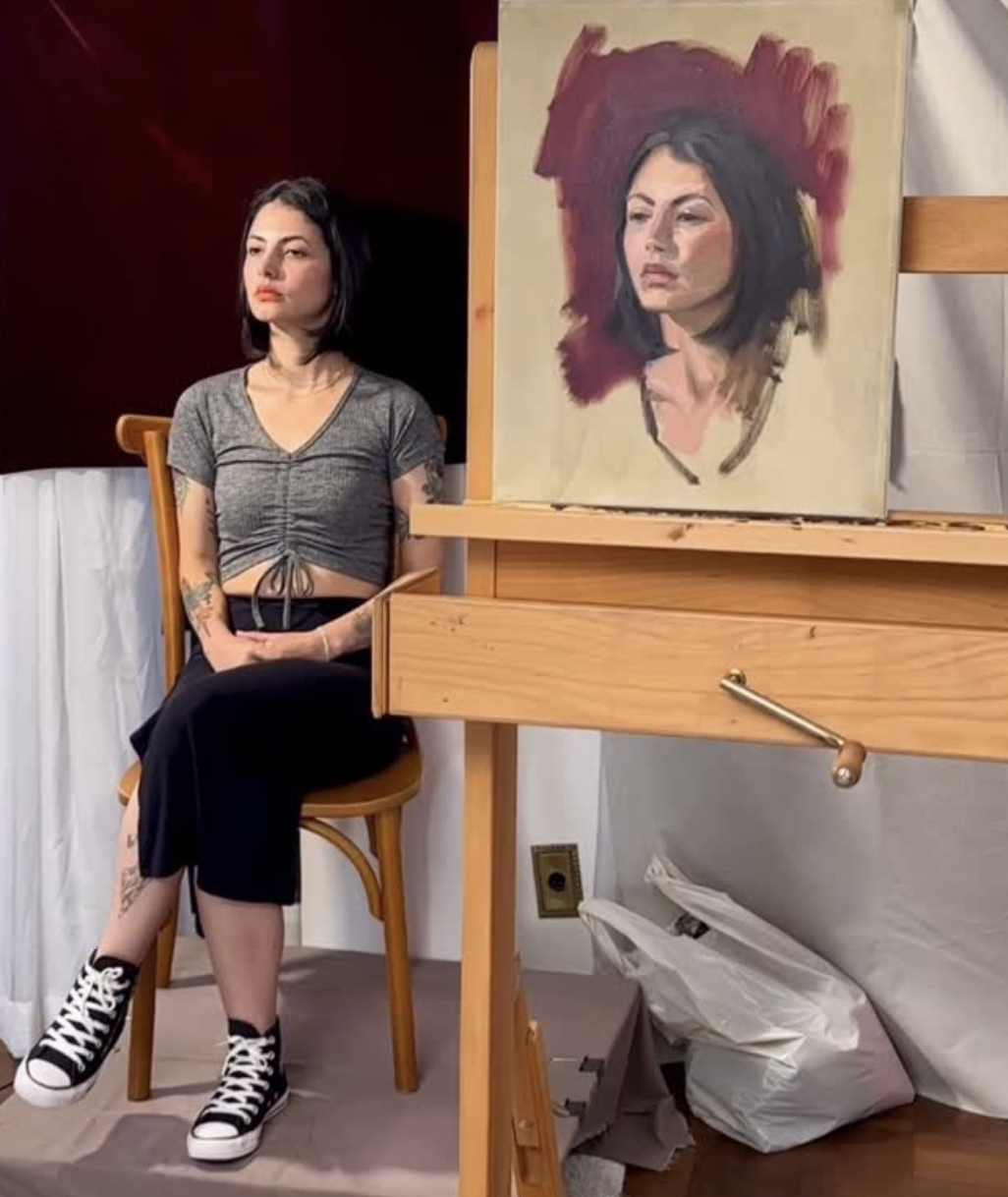
Life painting of Pâmela Vizin. Rochá, 2026. Photo courtesy of Marcelo A Rochá.
How can we make the art world better?
I think one way is by sharing knowledge more openly. I regularly show my painting process from beginning to end, and I see how much curiosity that creates. People save the videos because they want to understand the process or try something similar themselves. I also make an effort to answer questions I receive on Instagram, whether in comments or direct messages. And I believe in making more in-depth education accessible to people who want to begin painting or explore a different technique or approach. These are practical ways I try to contribute.
Who is another artist that you think is actively making the world a better place, whatever ‘a better place’ means to you?
I believe all artists, across every artistic discipline, are making the world a better place, each contributing in their own way.
What social, cultural, and/or charitable cause do you care deeply about?
I care deeply about abandoned animals, especially dogs and cats. Recently, my wife and I adopted Rebecca, a ten-year-old Shih Tzu who came into our lives. Every morning, as soon as we wake up, we go for a long walk and feed more than thirty cats, most of them strays who gather in particular places. Caring for animals is a very important part of our lives.
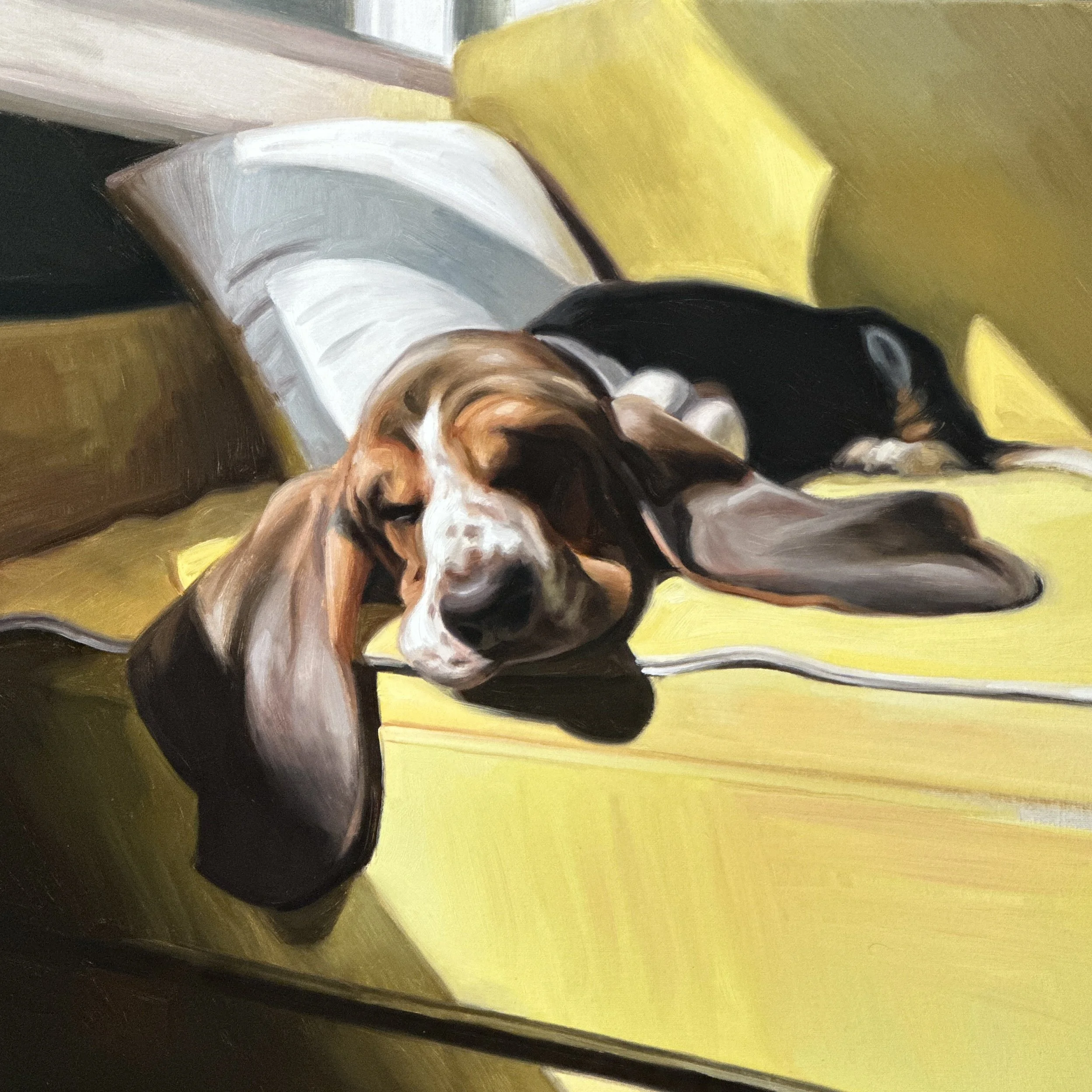
Commissioned pet portrait. Rochá, 2025. Photo courtesy of Marcelo A Rochá.
What natural element do you relate to most? Air, fire, earth, water?
I've never really thought about that, but I would say earth.
What is your biggest dream goal you want to achieve in your artistic career?
My biggest goal is simply to keep painting more and painting better. Other goals, like winning a painting salon or receiving recognition, feel secondary to me. I believe those things are consequences of continually improving as a painter.
What do you want people to remember about your practice?
I want people to remember my paintings because they help them remember their beloved dogs and cats. The goal isn't for people to remember me or my artistic practice, but to remember their pets. I'm simply an instrument in that process.
ART ZAZA believes in the power of kindness and community support for those who may need it. Inspired by Rochá’s love of animals, ART ZAZA encourages readers to check out animal welfare charities and organisations, such as Encontrei um Amigo in Brasil and the Humane Society of New York.
Interview by Eliza Palmer
ART ZAZA would like to thank Marcelo A Rochá for his participation. Learn more about Rochá, his online course, and how to place a commission order on his website, www.marceloarocha.com, and on his Instagram account, @artrocha.